HOTEL TECHNOLOGY • MULTI-PROPERTY OPERATIONS • SAUDI ARABIA
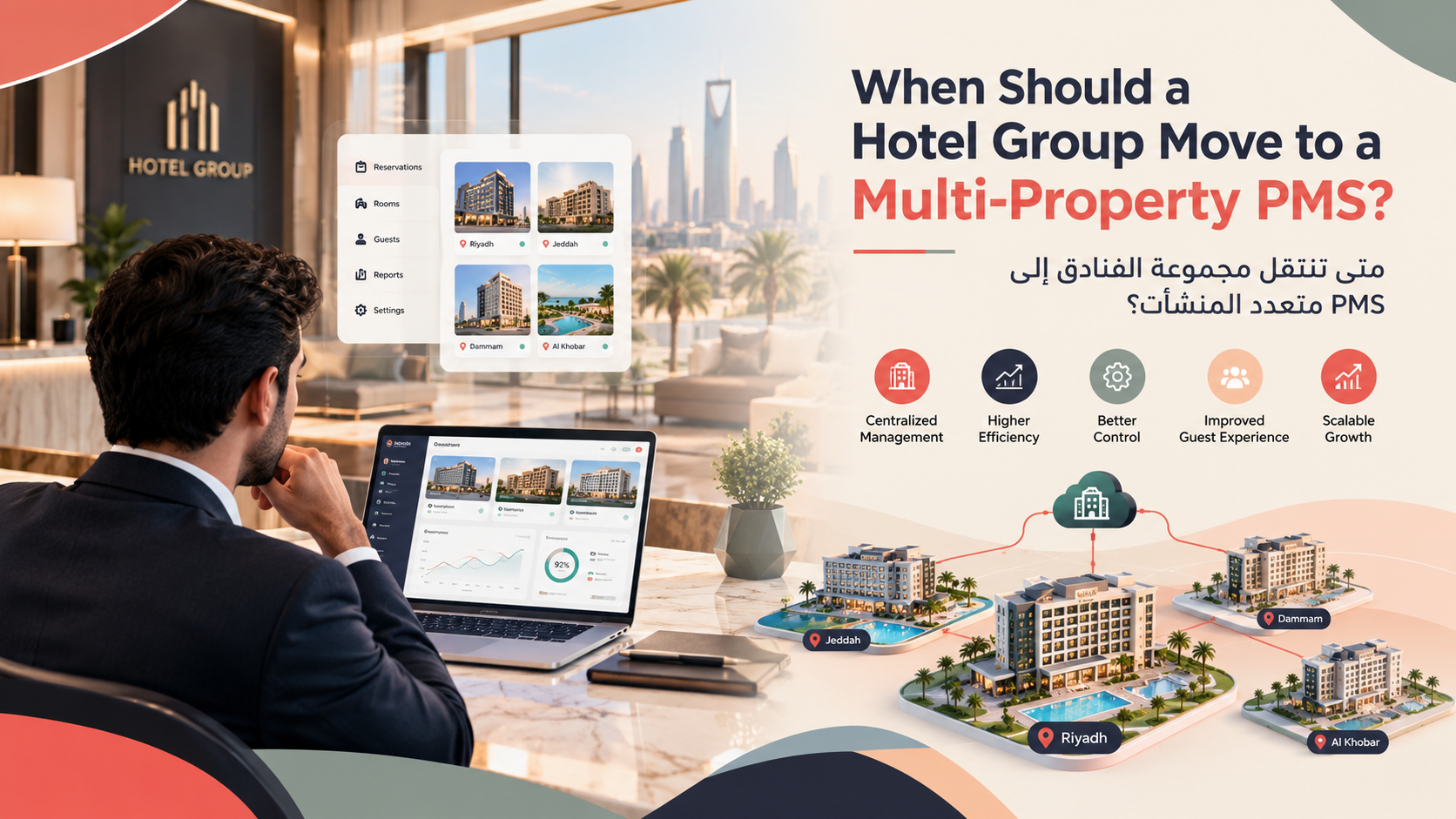
When Should a Growing Hotel Group Move to a Multi-Property PMS?
A practical guide for hotel owners, operators, and hospitality groups deciding when separate property systems become a growth constraint — and when a centralized multi-property PMS becomes the smarter operating model.
Primary Keyword: multi-property PMS
Secondary Keywords: hotel PMS, multi-property hotel management, hotel management software, cloud PMS, hotel group software, centralized hotel operations, hotel property management system, hotel technology Saudi Arabia
Long-Tail Keywords: when should a hotel group use a multi-property PMS, best multi-property PMS for hotel groups, centralized hotel PMS in Saudi Arabia, PMS for multiple hotels, multi-property hotel management software Saudi Arabia, how to manage multiple hotels from one system, cloud PMS for growing hotel groups
Search Intent: Informational + commercial investigation for hotel owners and hospitality operators evaluating when to centralize technology.
The Quick Answer: When Should a Hotel Group Switch?
There is no universal rule such as “move after five hotels” or “switch after 500 rooms.” The right time to move to a multi-property PMS is when managing each hotel separately starts creating duplicated work, inconsistent rates and inventory, fragmented guest data, slow reporting, difficult compliance processes, or limited visibility for head office.
Introduction: Growth Changes the PMS Problem
Running one hotel is fundamentally different from running a growing hotel group. At one property, a manager can often see the front desk, understand today's arrivals and departures, review occupancy, speak directly with housekeeping, and solve issues quickly. As the portfolio expands, that same management model becomes harder to maintain.
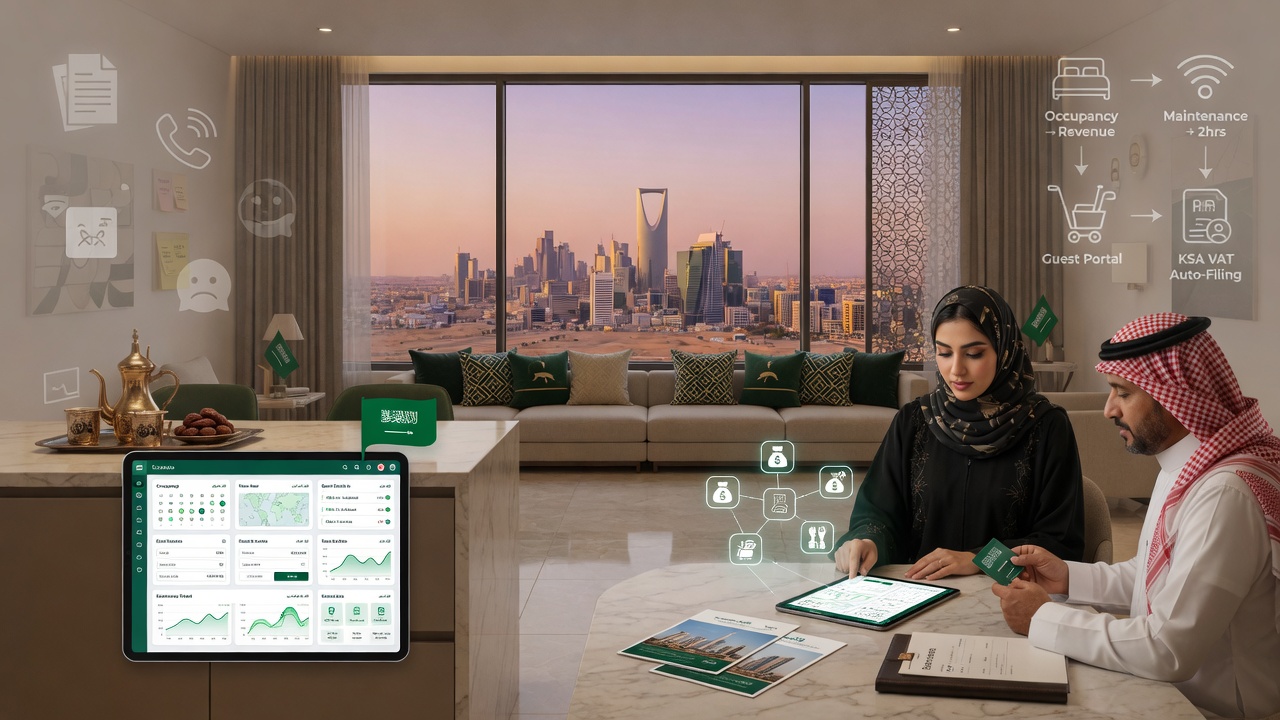
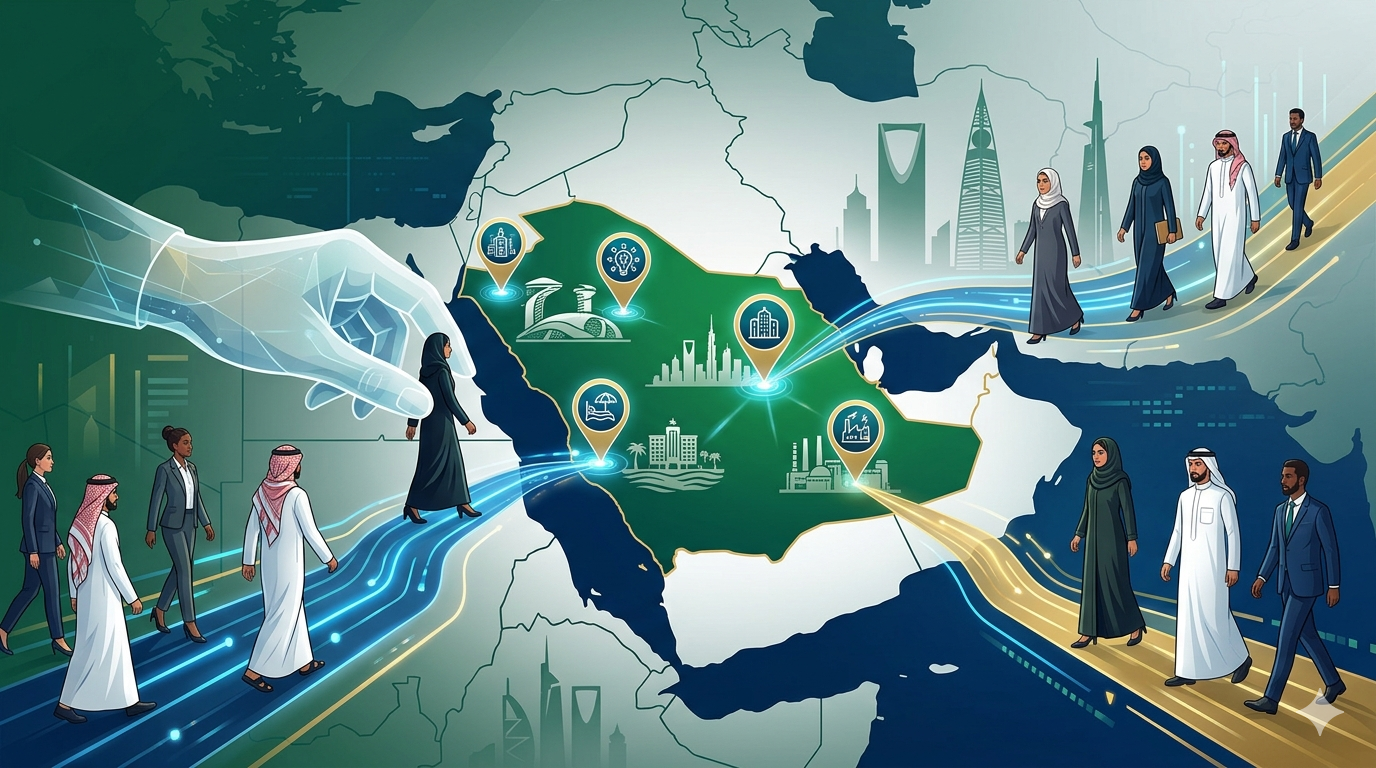
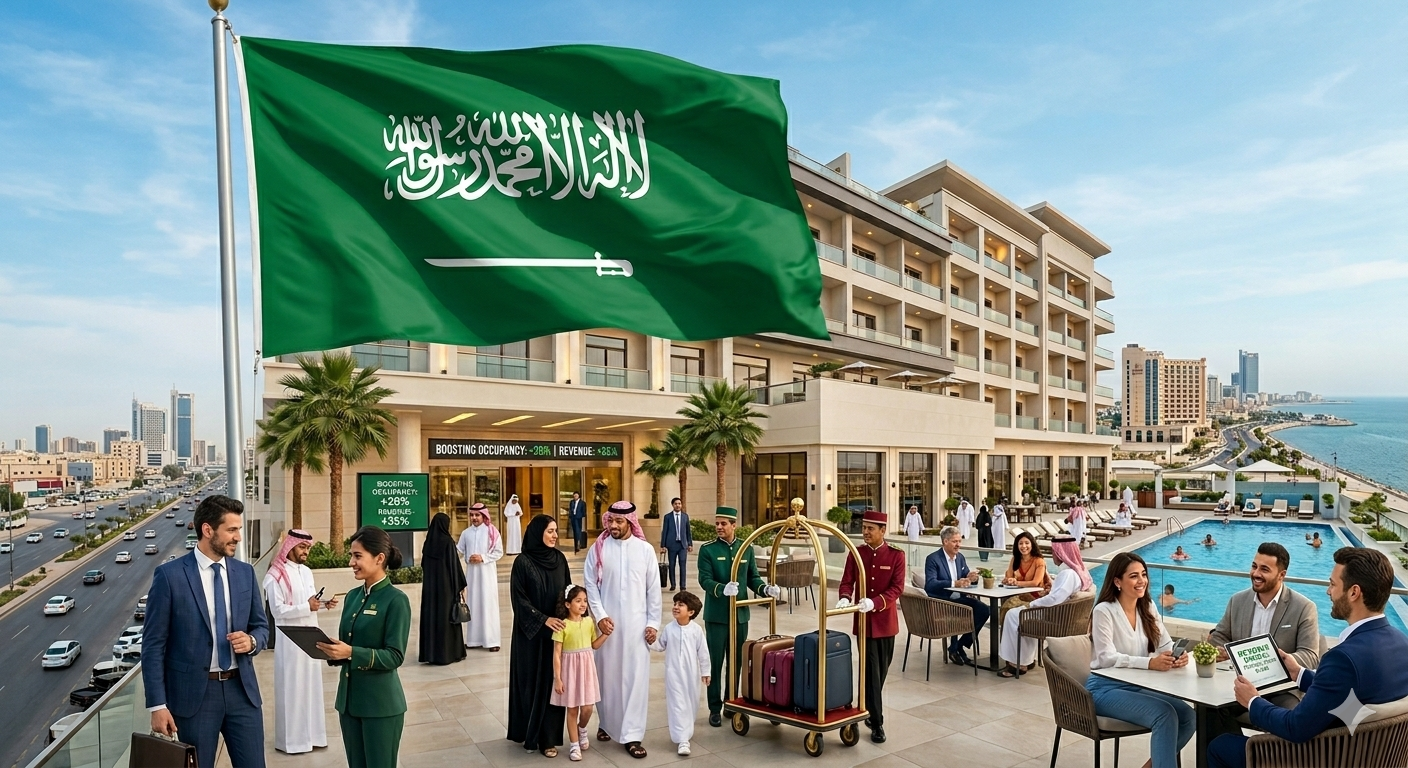
A group with hotels in Riyadh, Jeddah, Dammam, Al Khobar, Makkah, Madinah, or other destinations may have different room types, rate plans, staffing structures, seasonal demand patterns, distribution channels, and operational procedures. Each individual property may still function well, while the group as a whole becomes increasingly difficult to control.
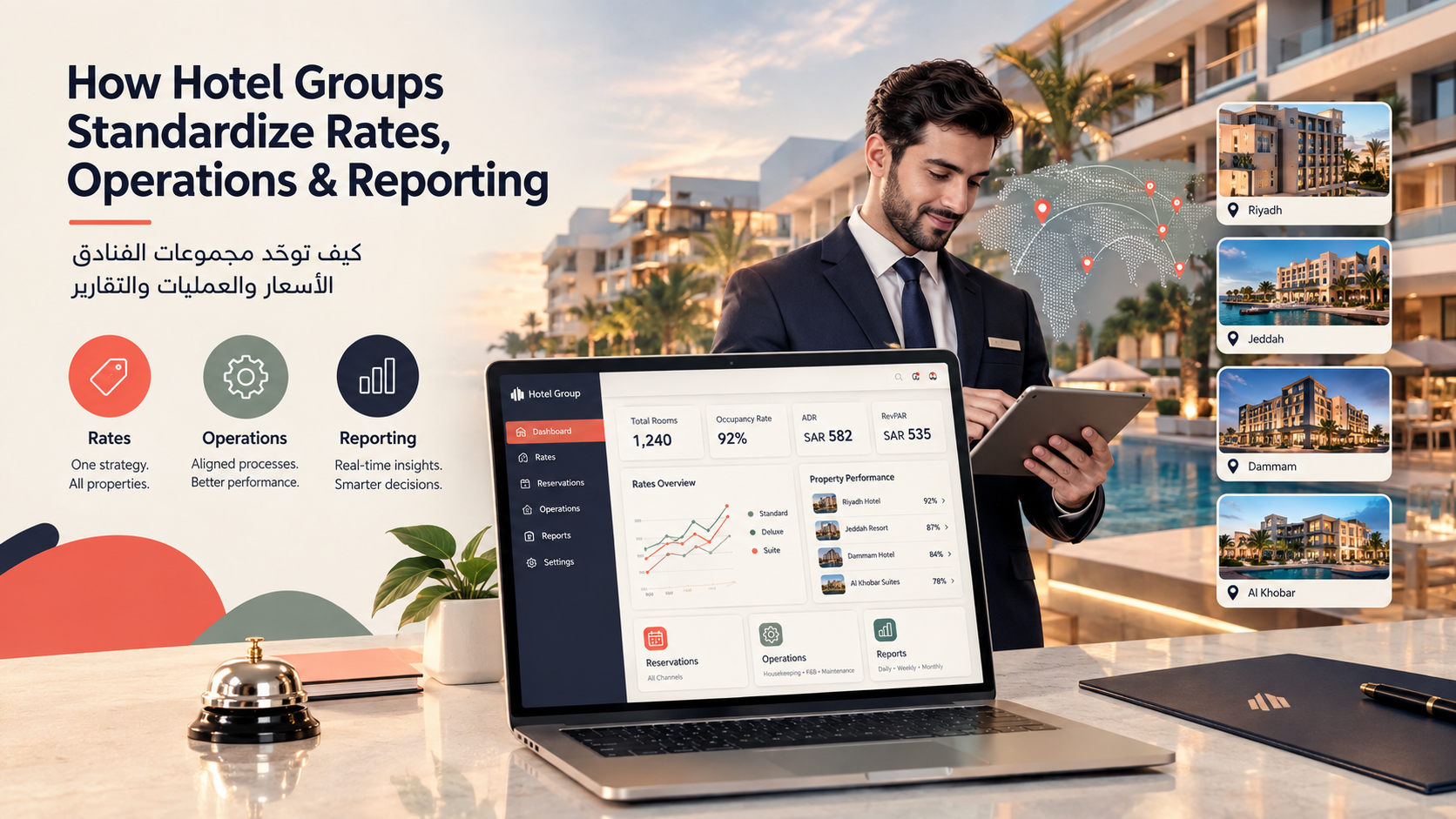
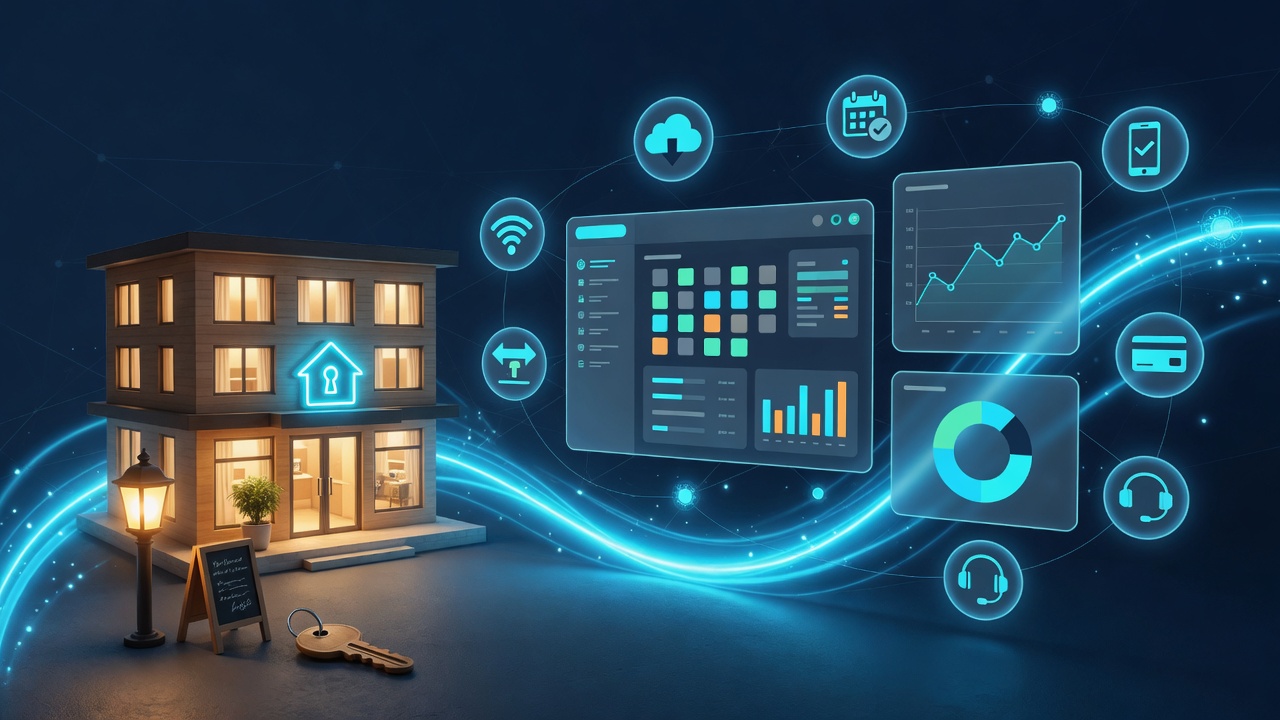
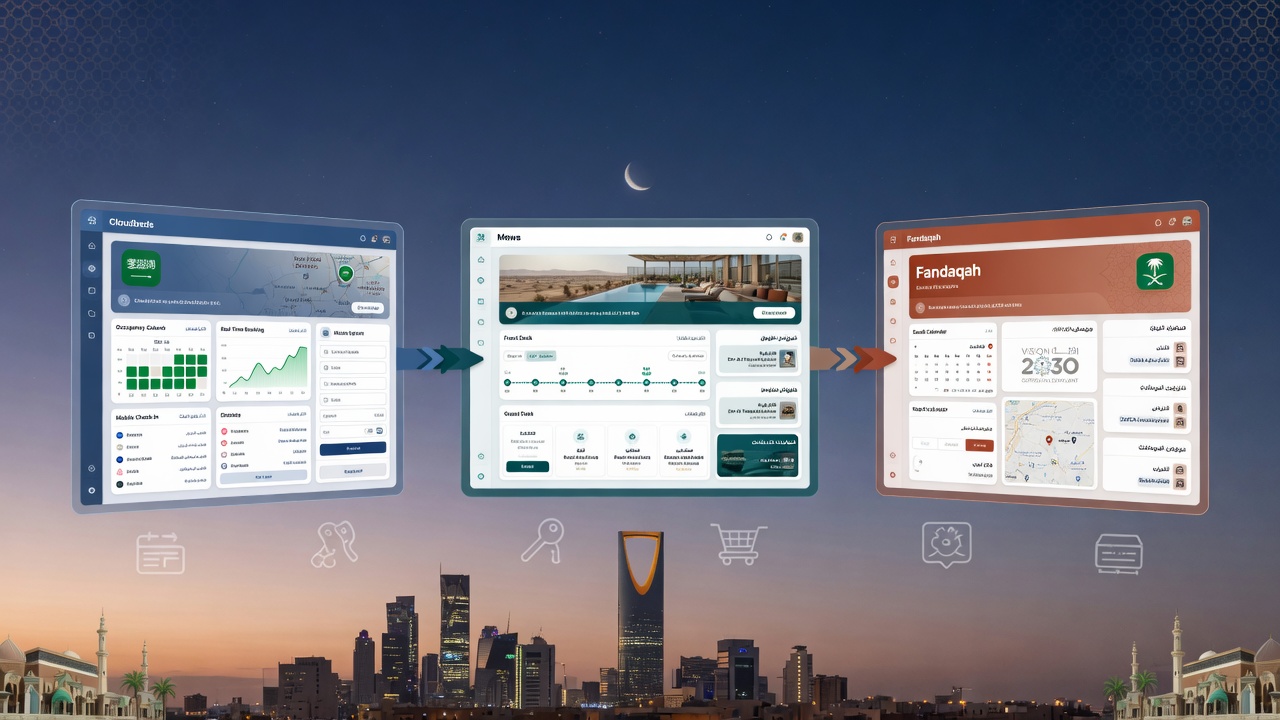
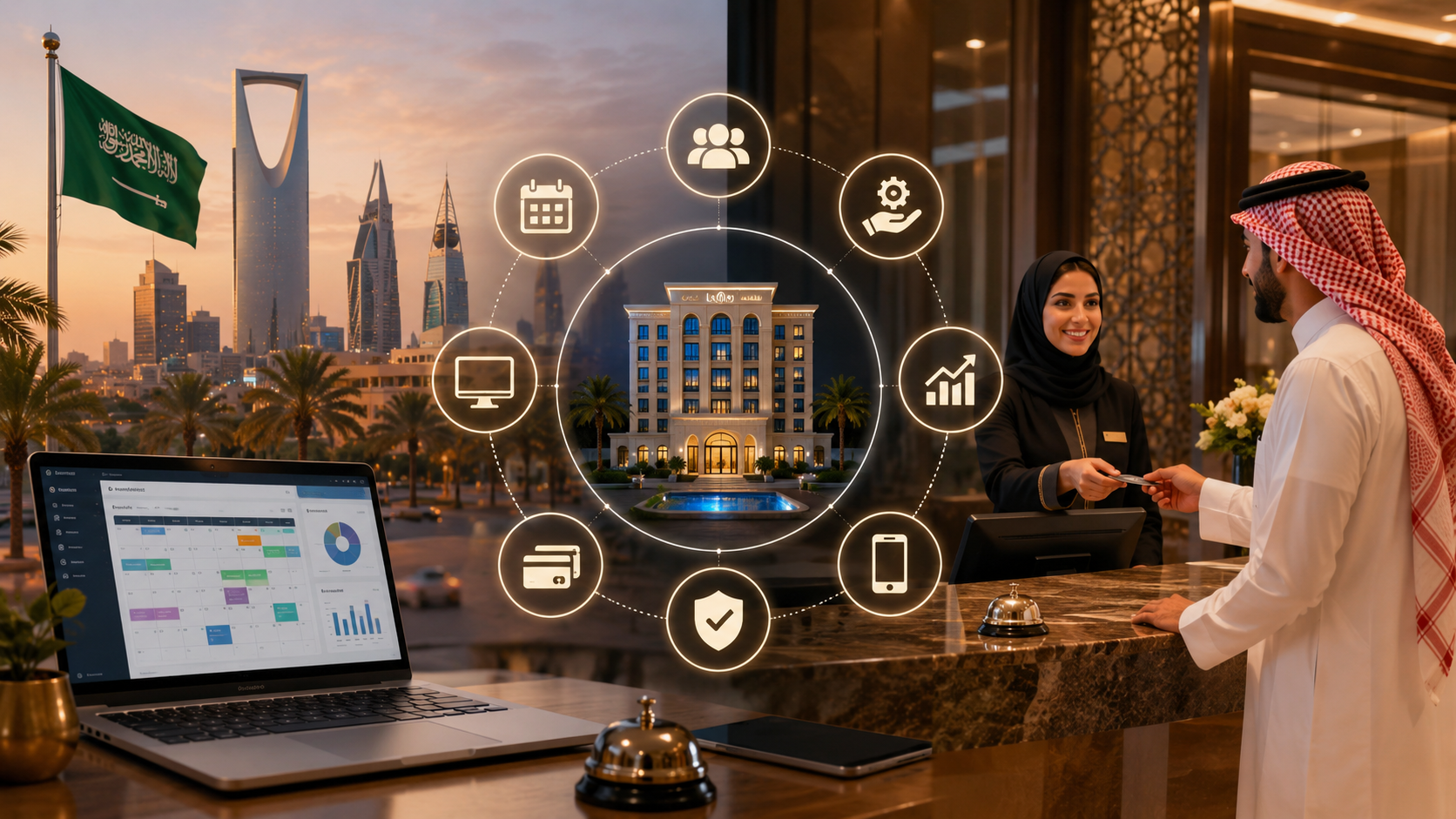
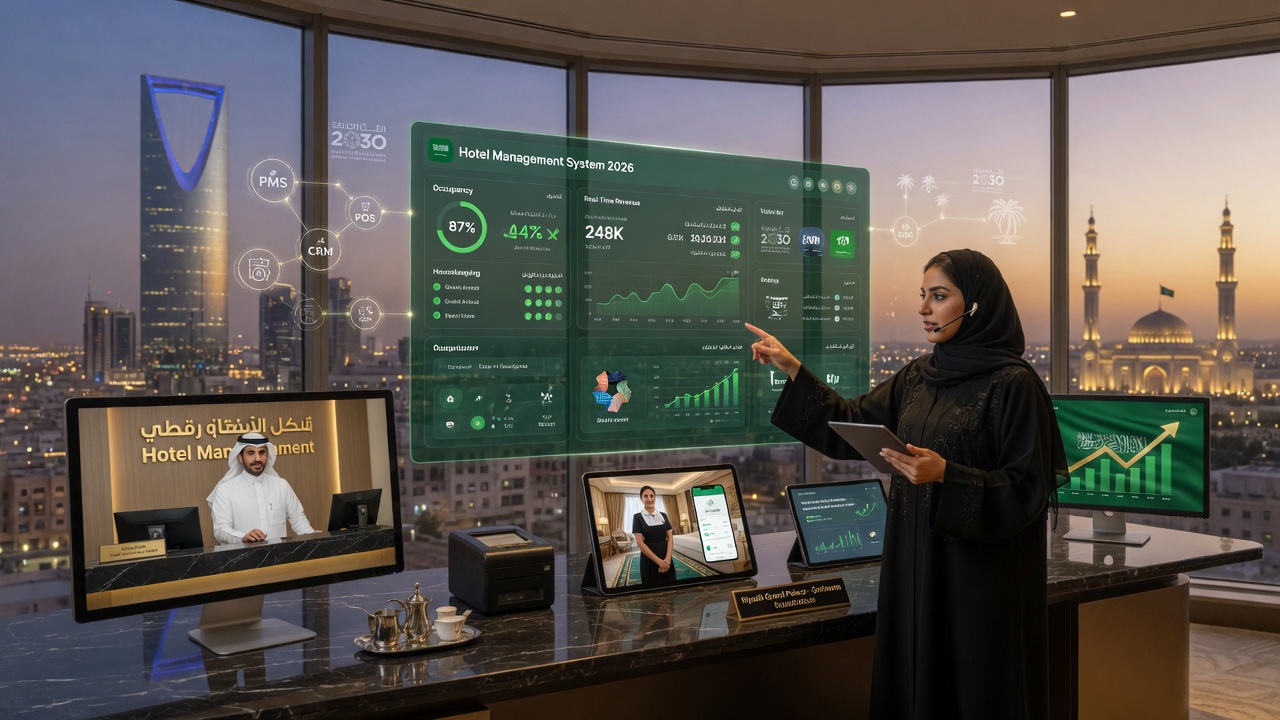
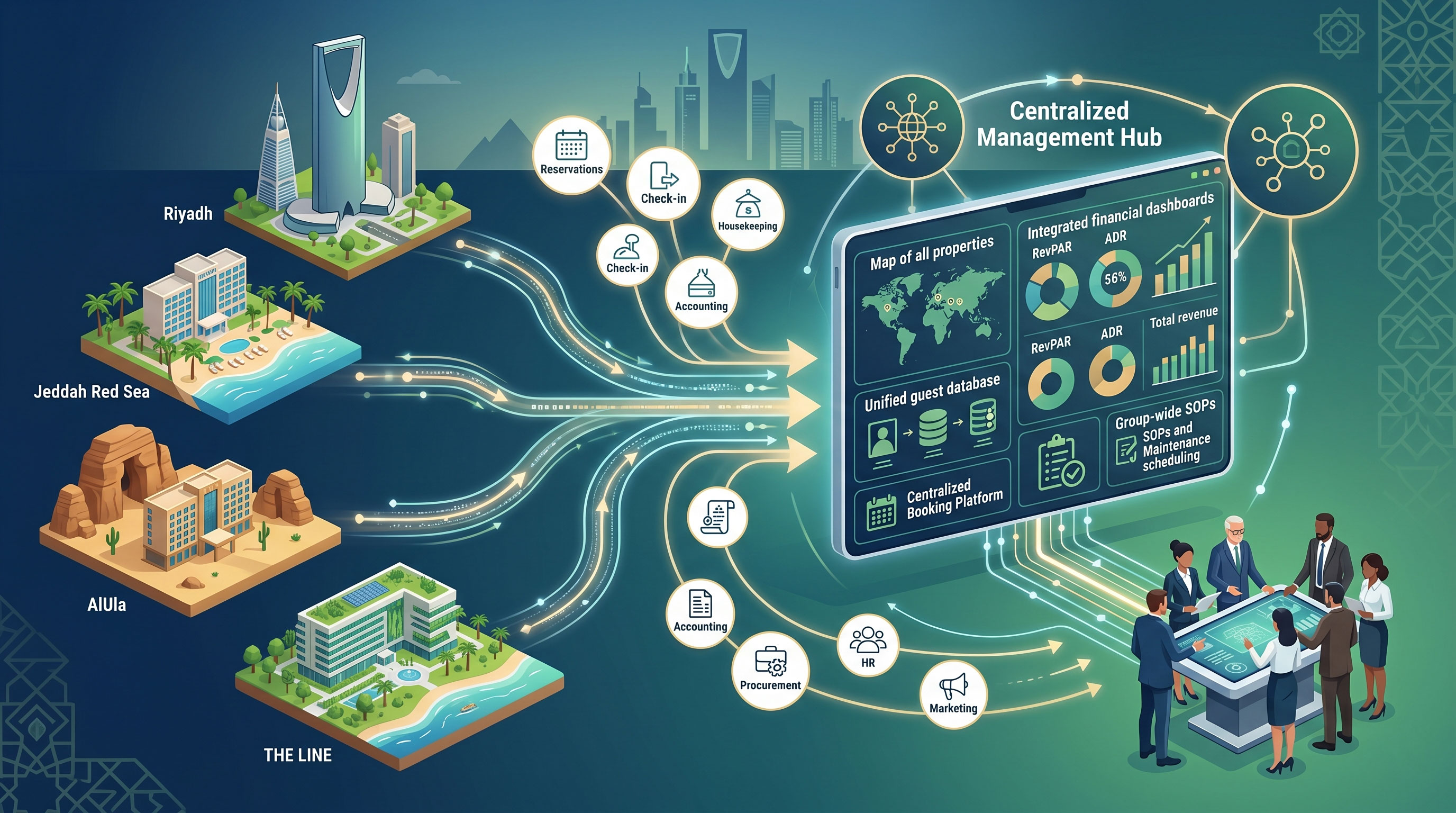
This is where the concept of a multi-property PMS becomes important. Instead of treating every hotel as an isolated technology environment, a multi-property property management system allows the group to establish shared standards and centralized visibility while retaining property-level control.
“The real trigger for multi-property PMS adoption is not the number of properties. It is the amount of operational complexity created by having more than one property.”
What Is a Multi-Property PMS?
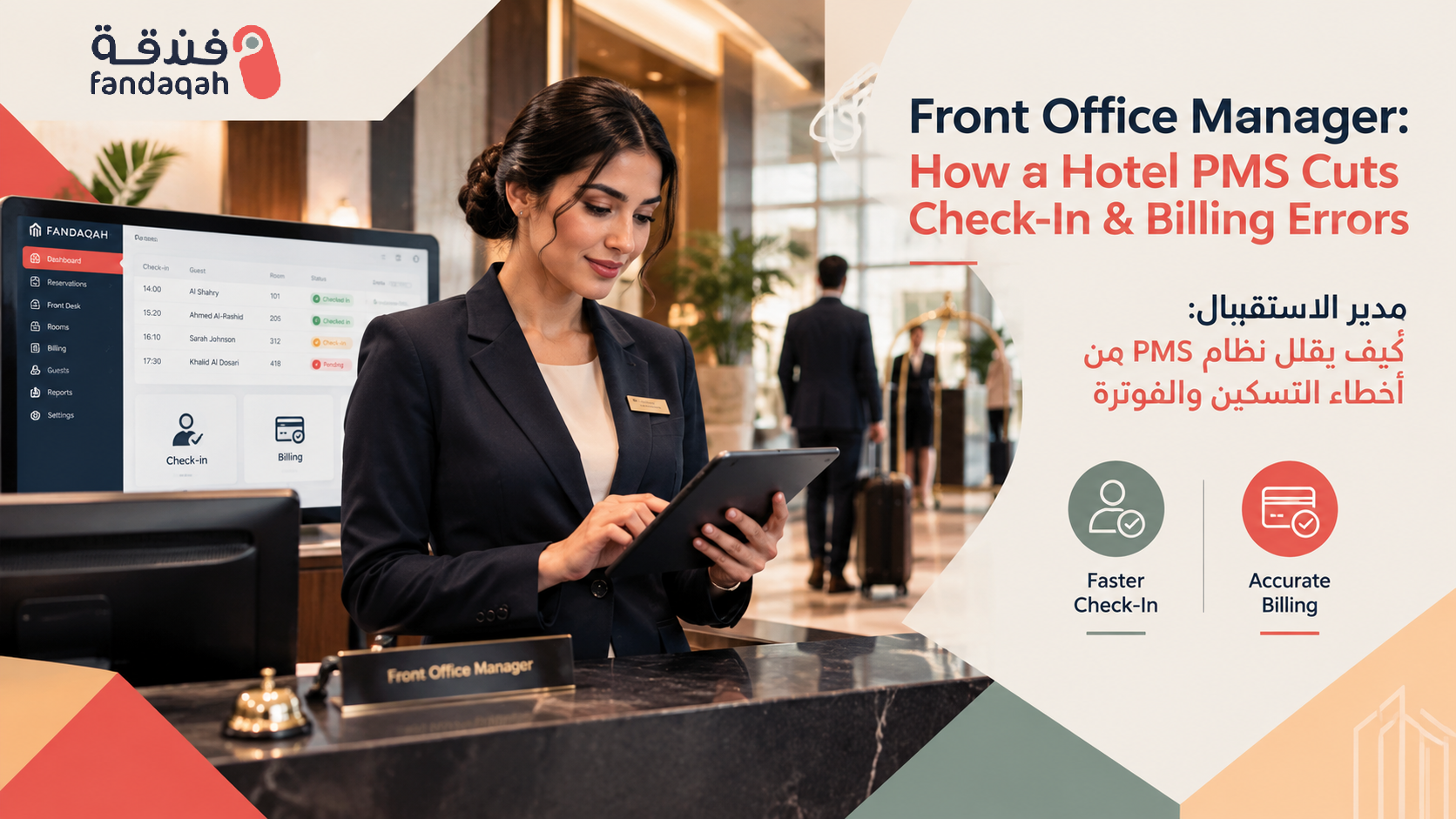
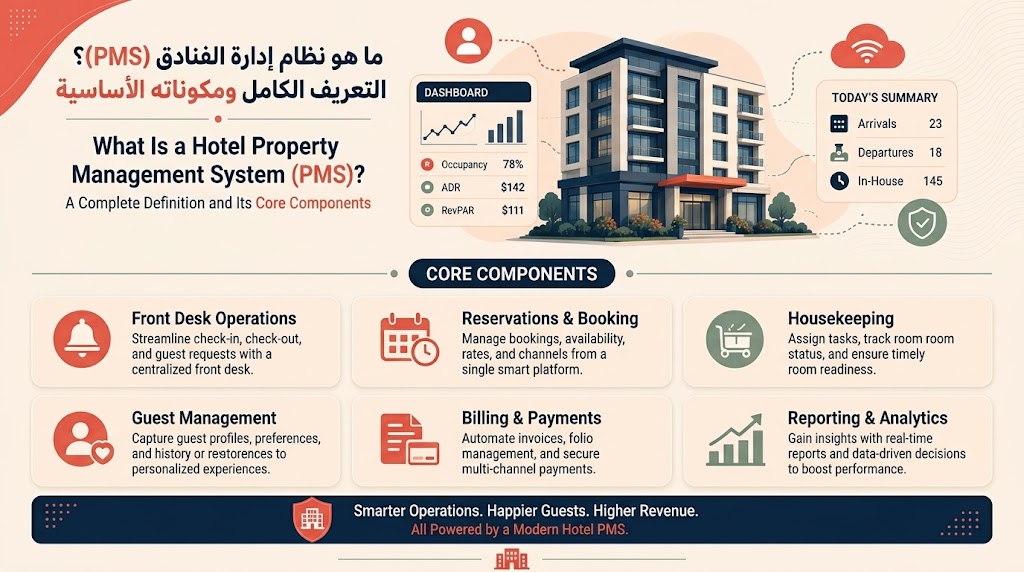
A Property Management System (PMS) manages core hotel operations such as reservations, room inventory, check-in, check-out, guest information, room status, housekeeping workflows, reporting, and other daily processes.
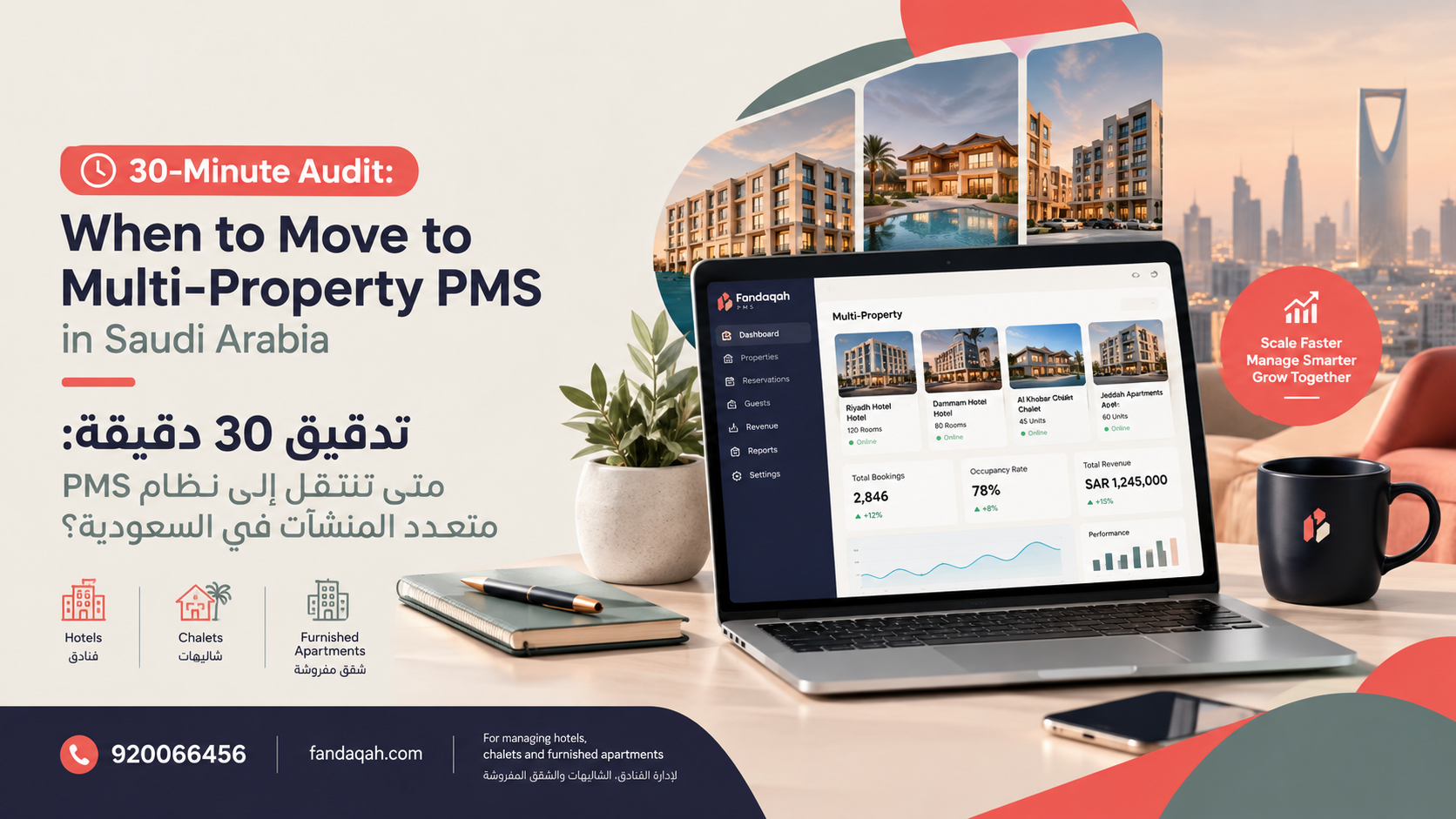
A multi-property PMS extends that operating model across multiple hotels, serviced apartments, resorts, chalets, or other accommodation properties. The important concept is centralization: authorized users can manage and analyze more than one property through a connected technology environment instead of maintaining completely separate systems.
That distinction matters because a group needs two things at the same time:
- Standardization: consistent processes, reporting structures, permissions, data definitions, rate controls, and technology governance.
- Local control: each property still needs flexibility for its own inventory, team, guest profile, operating hours, services, and market conditions.
A well-designed multi-property PMS therefore should not simply copy one hotel's setup across every property. It should create a shared framework while allowing controlled differences where those differences are operationally necessary.
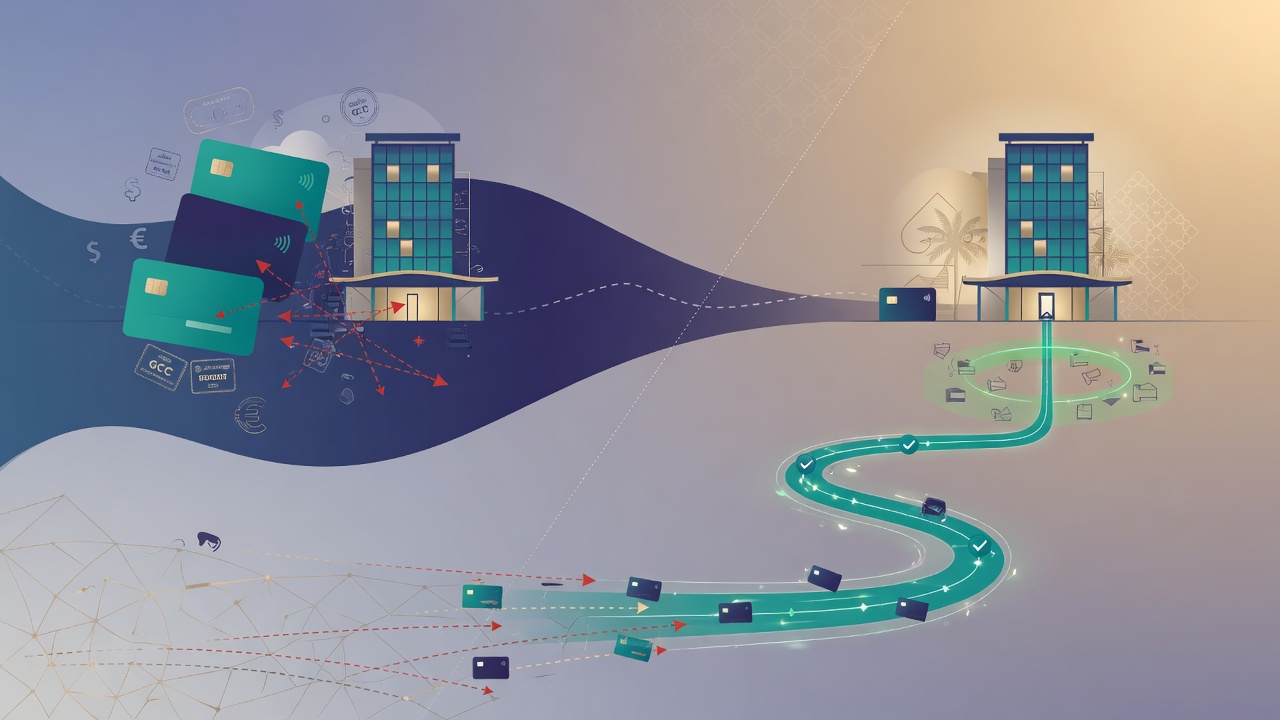
The First Sign: Your Team Is Managing the Same Information More Than Once
One of the earliest warning signs is duplicated administration.
For example, imagine a hotel group operating four properties. The reservations team changes a room rate, front-office teams update availability, revenue staff prepare reports, finance reconciles figures, and management requests consolidated occupancy information. If every property uses a separate workflow, the same information may be entered, exported, checked, emailed, and reconciled multiple times.
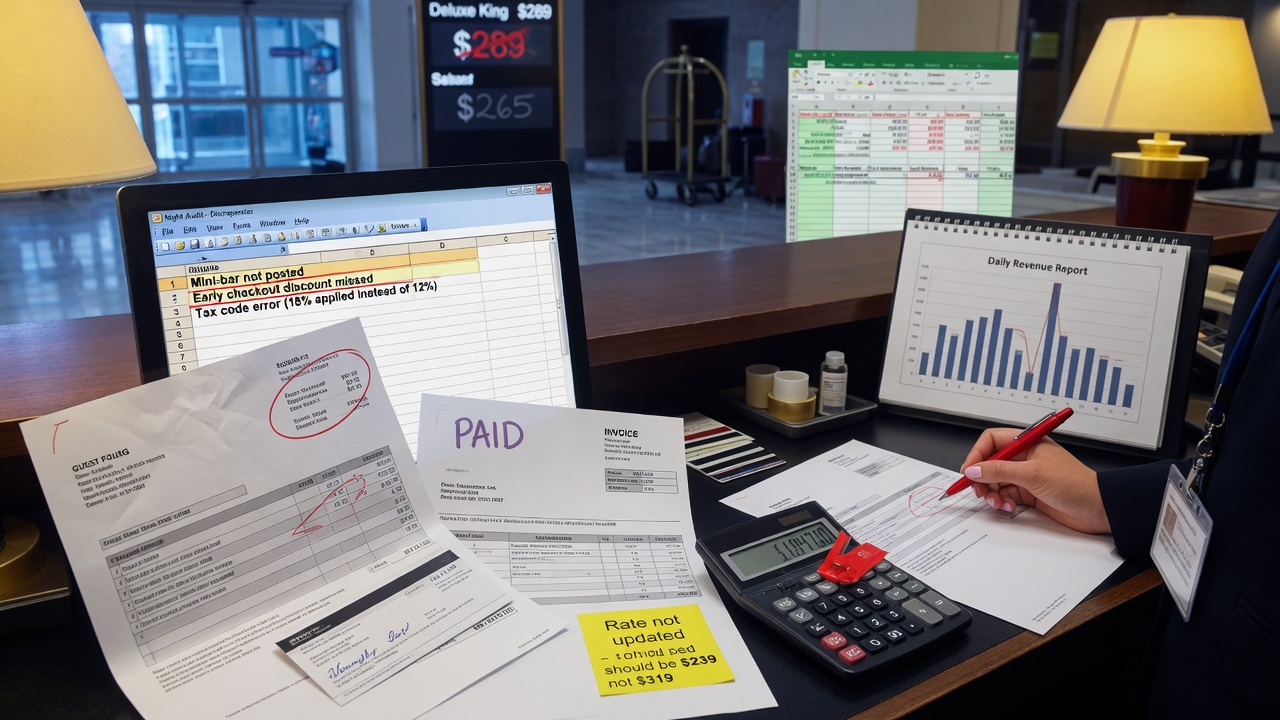
The problem is not simply that employees spend more time on administration. Repeated data entry also increases the opportunity for human error.
Operational Warning Signs
- Managers maintain separate spreadsheets for each property.
- Head office waits for daily or weekly reports from individual hotels.
- Rates and availability require manual checking across several channels.
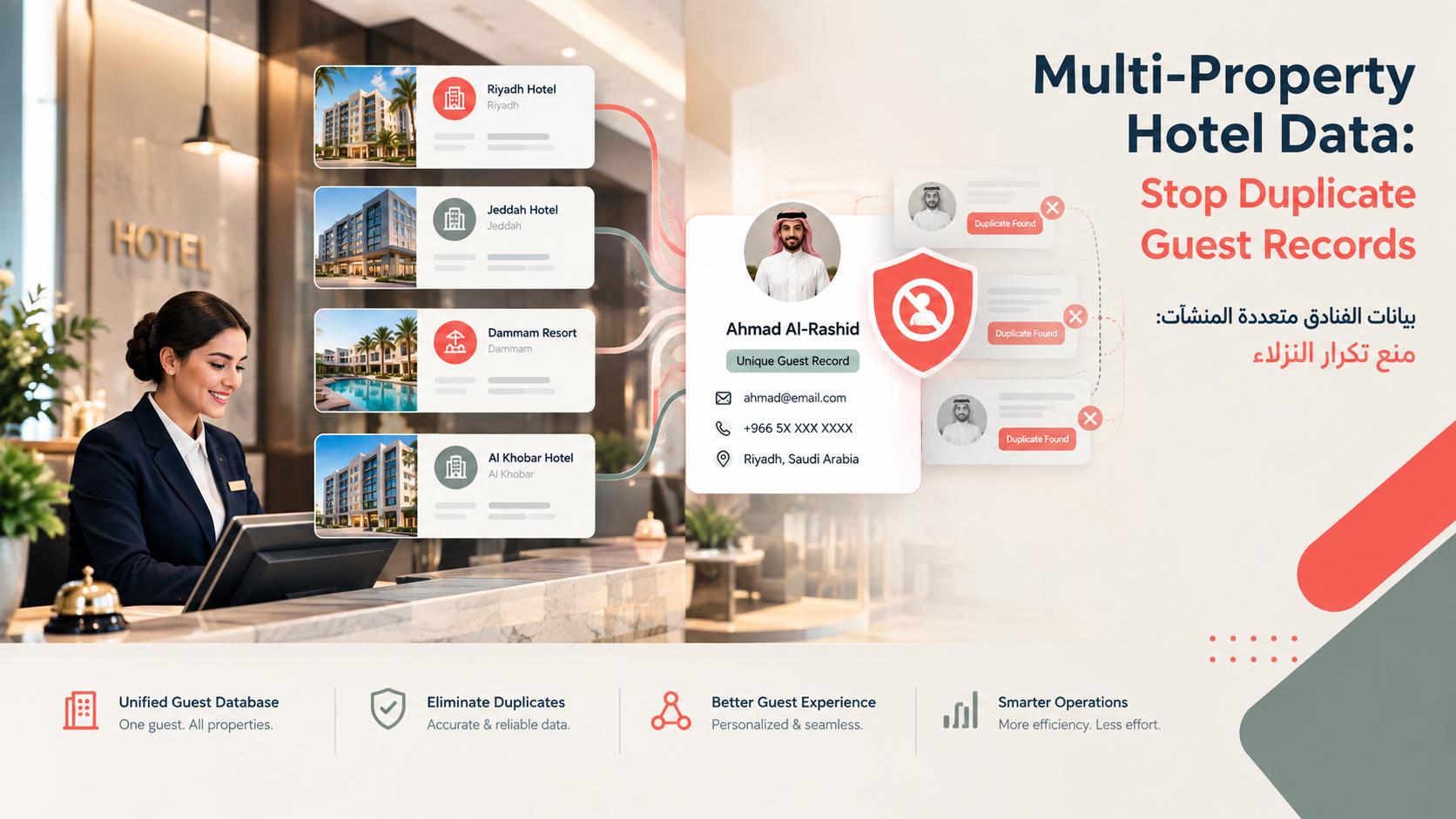
- Guest information is trapped inside separate property databases.
- Finance spends significant time consolidating property reports.
- Management cannot quickly compare occupancy, revenue, or performance across locations.
- New property launches require rebuilding processes from scratch.
10 Practical Signs You Have Outgrown a Single-Property PMS Model
1. You Operate Two or More Properties With Shared Management
Multiple properties do not automatically require a multi-property PMS. However, the need becomes stronger when the same owners, revenue team, reservations team, finance team, or operations leadership oversee more than one property.
2. Head Office Needs a Group-Level View
If leadership constantly asks individual hotels for occupancy, room revenue, booking pace, arrivals, departures, or operational figures, your data architecture may already be too fragmented.
3. You Are Expanding Into New Cities
Geographic growth introduces complexity. A hotel in Riyadh may behave differently from a coastal property in the Eastern Province or a leisure-oriented property elsewhere in the Kingdom. A scalable PMS should allow central standards without forcing identical operating assumptions onto every property.
4. Your OTA Workload Is Increasing
More properties usually mean more distribution activity. Booking channels can become difficult to control when teams manually update rates and availability in separate interfaces. A connected PMS and channel manager can reduce repetitive distribution work and help keep inventory synchronized.
5. You Are Seeing Duplicate or Inconsistent Data
Duplicate guest profiles, inconsistent room types, different reporting labels, and conflicting revenue figures are classic signs that your systems are operating as isolated islands.
6. Finance Needs Too Much Manual Consolidation
A growing hotel group should not depend on a recurring cycle of exporting spreadsheets from every property and manually combining them before management can understand portfolio performance.
7. Your Guest Experience Is Inconsistent
Guests who stay at two properties under the same group should not need to feel as though they are interacting with completely unrelated businesses because the underlying technology cannot recognize shared information or operating standards.
8. Onboarding New Staff Takes Too Long
Multiple software environments create additional training requirements. Standardized workflows can make cross-property staffing, training, and internal mobility easier.
9. Opening a New Property Feels Like a Technology Project Every Time
When every opening requires a separate collection of tools, integrations, reports, credentials, and operating procedures, technology becomes a drag on expansion instead of an enabler.
10. Management Decisions Are Slower Than the Business
This is perhaps the most important sign. If an executive needs to wait for information that already exists somewhere inside the organization, your reporting architecture is not keeping pace with the business.
Single-Property PMS vs Multi-Property PMS
The table does not mean every hotel group should immediately replace its existing systems. A smaller group may be perfectly comfortable with independent property systems. The key question is whether the cost of fragmentation is becoming larger than the cost and effort of centralization.
The Business Benefits of Moving to a Multi-Property PMS
Centralized Reporting
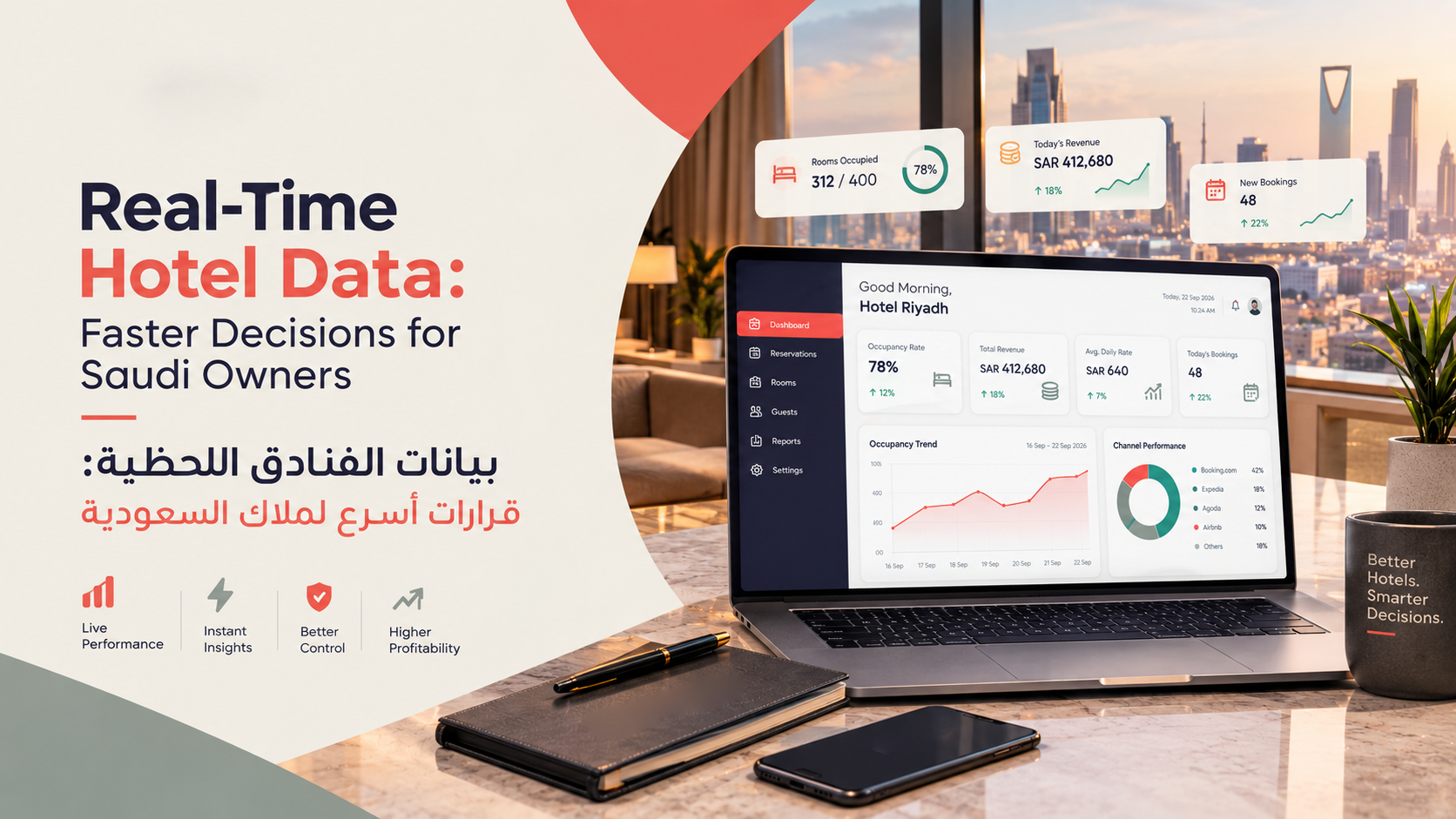
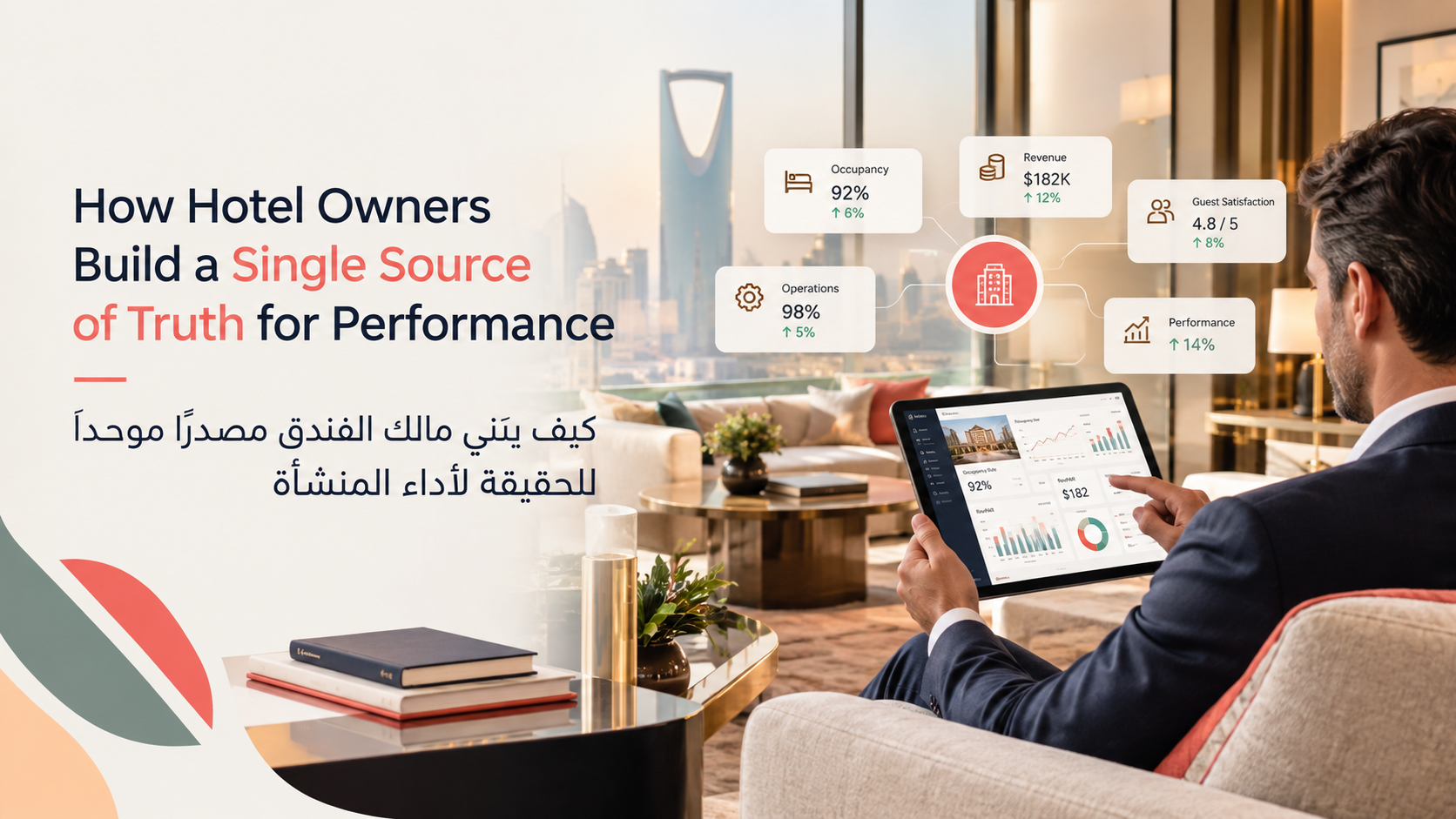
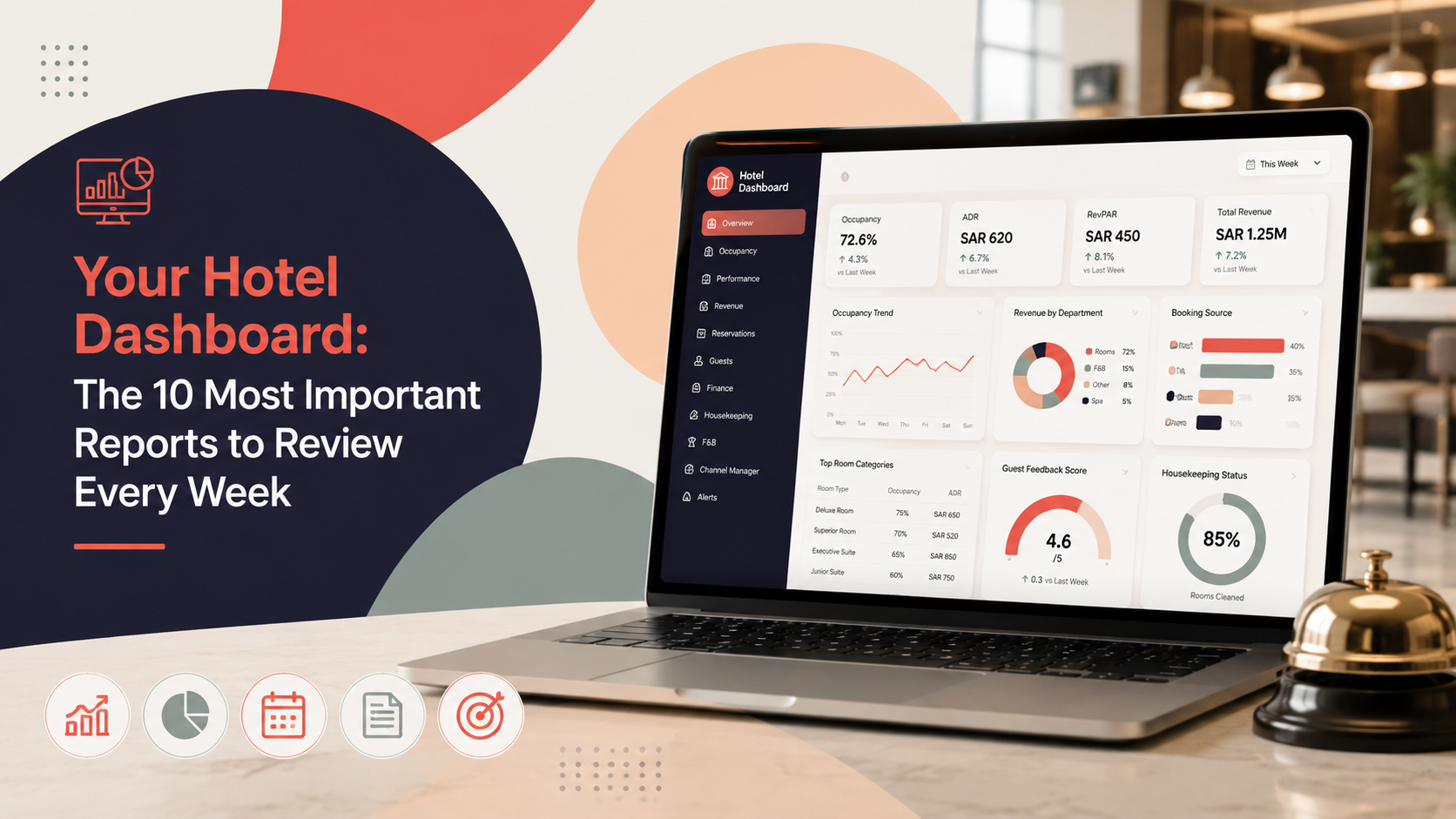
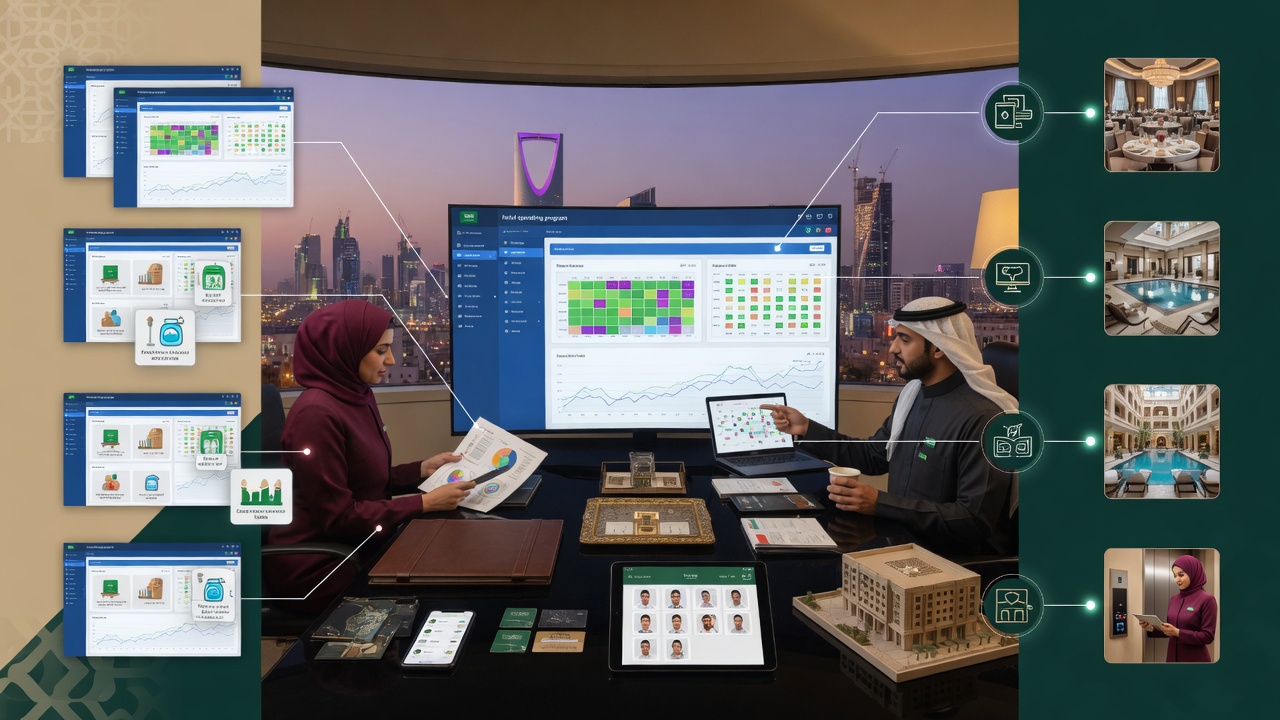
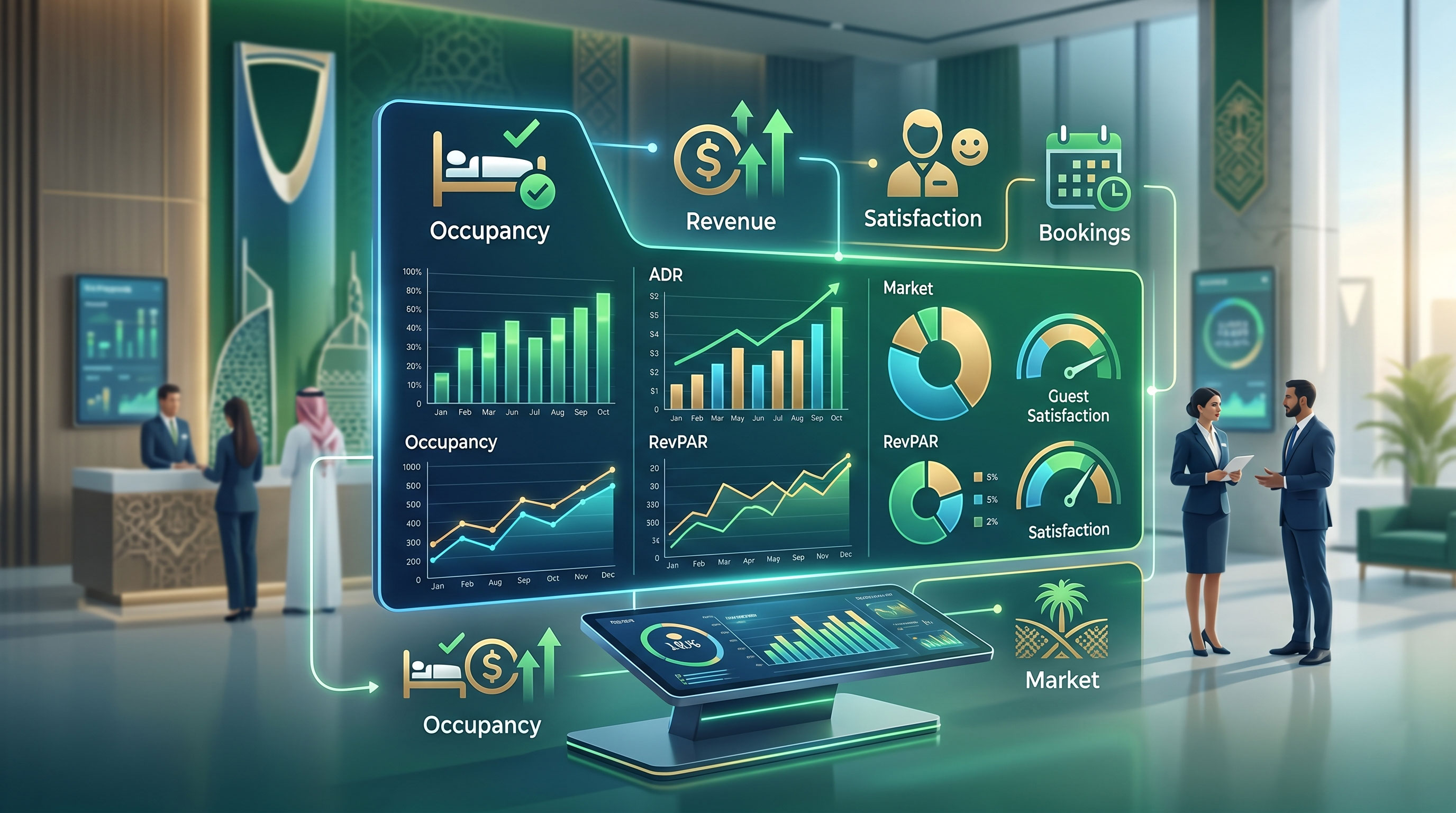
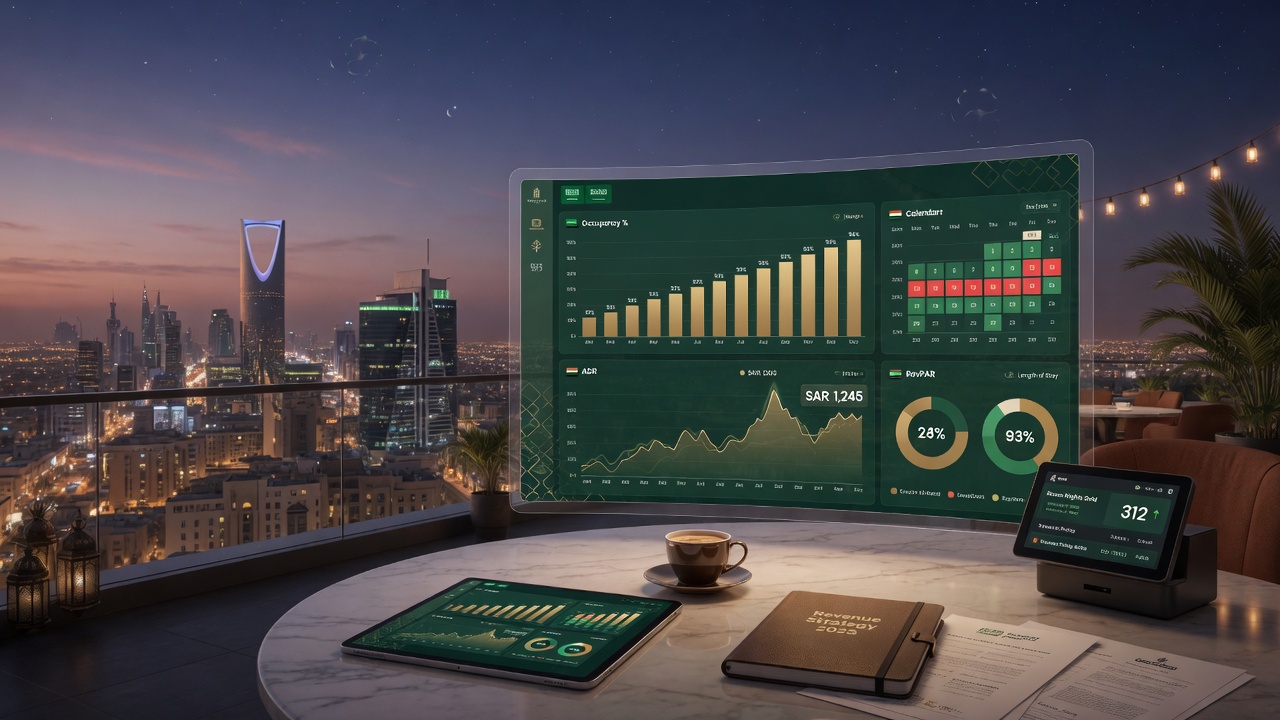
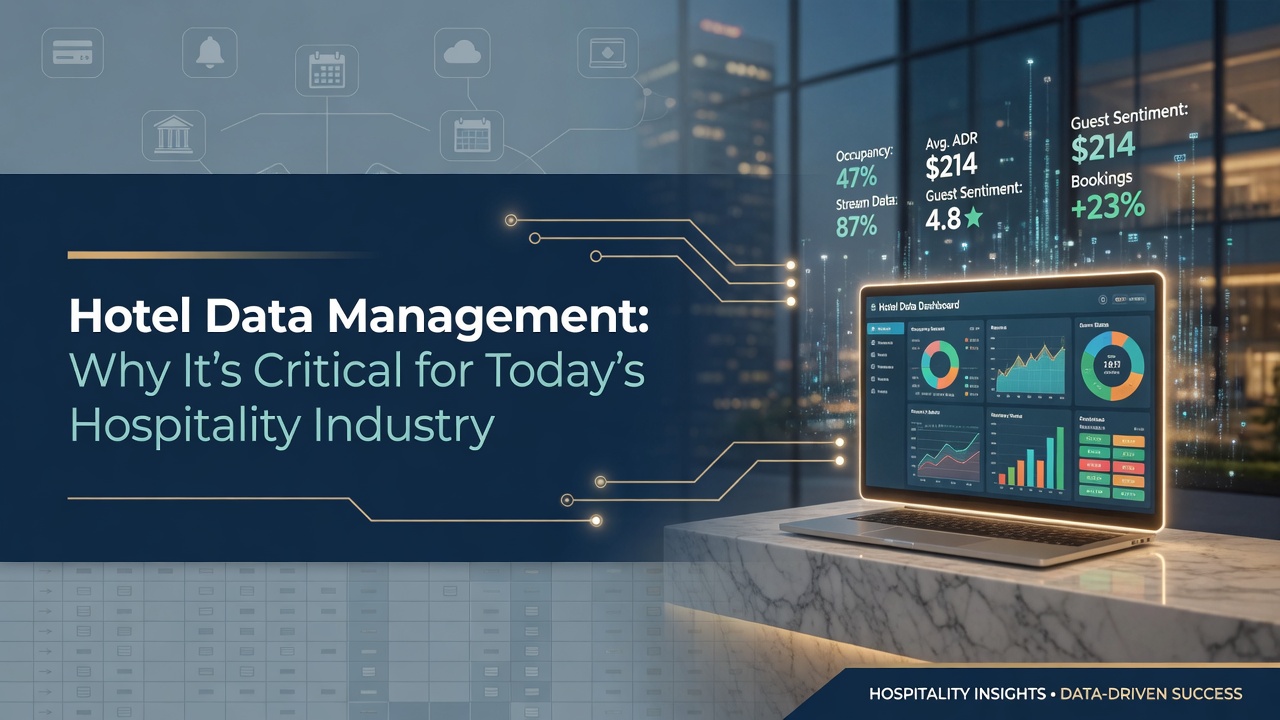
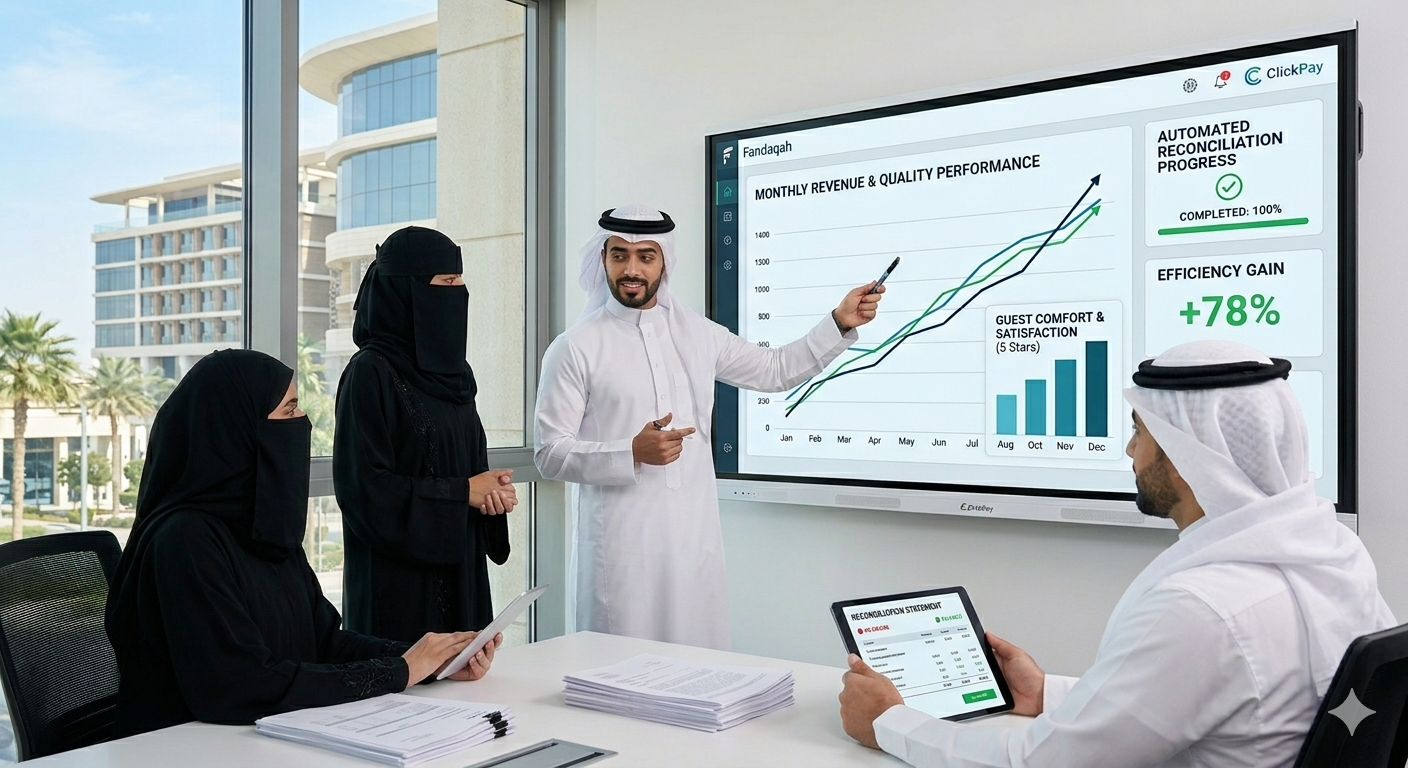
Executives need to understand the portfolio without requesting separate files from every property. A centralized environment can make occupancy, revenue, reservations, room status, and other operational metrics easier to review across the group.
Less Duplicate Work
When information can flow through connected systems, employees spend less time copying values between spreadsheets, dashboards, portals, and email reports.
Better Control of Rates and Inventory
Multi-property operations often involve several room types, rates, channels, promotions, and demand periods. A connected PMS and channel-management environment can give revenue and distribution teams better control over how inventory is sold.
More Consistent Processes
Hotel groups can define common workflows for reservations, check-in, room status, reporting, and other recurring activities while still preserving property-specific configuration.
Faster Expansion
Technology becomes more reusable. A new hotel can be added to an established framework instead of starting with an entirely separate technology stack.
Improved Management Visibility
Management can move from asking “What happened at each hotel?” to asking “What is happening across the portfolio, and where should we act?”
A Useful Test
Ask your management team to produce a consolidated snapshot of yesterday's occupancy, room revenue, arrivals, departures, cancellations, and channel performance across every property. Then measure how long it takes and how many manual steps are involved. That exercise often exposes the real cost of fragmented systems.
Why This Matters Particularly in Saudi Arabia
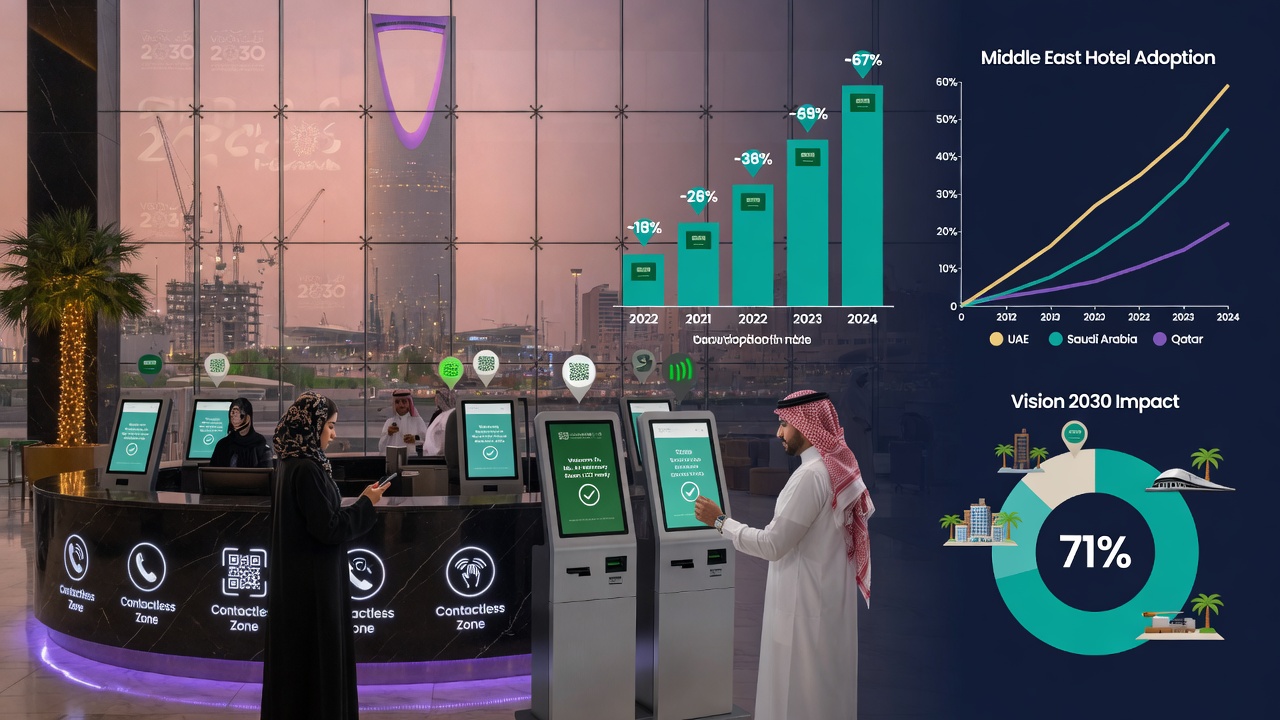
Saudi Arabia's hospitality market is developing rapidly. The Ministry of Tourism's current National Tourism Strategy presents a target of 150 million domestic and inbound tourists and a tourism-sector contribution target of 10% of GDP, alongside a target of 1.6 million tourism jobs by 2030.
The Kingdom had already exceeded the original 100-million-visitor Vision 2030 target, and the target was subsequently raised. The 2025 Vision 2030 Annual Report describes the 100-million target as having been exceeded ahead of schedule and identifies 150 million visitors by 2030 as the updated target.
For hotel groups, this environment creates a practical technology question: can the operating model support more properties, more guests, more channels, more transactions, and more reporting without simply adding more manual work?
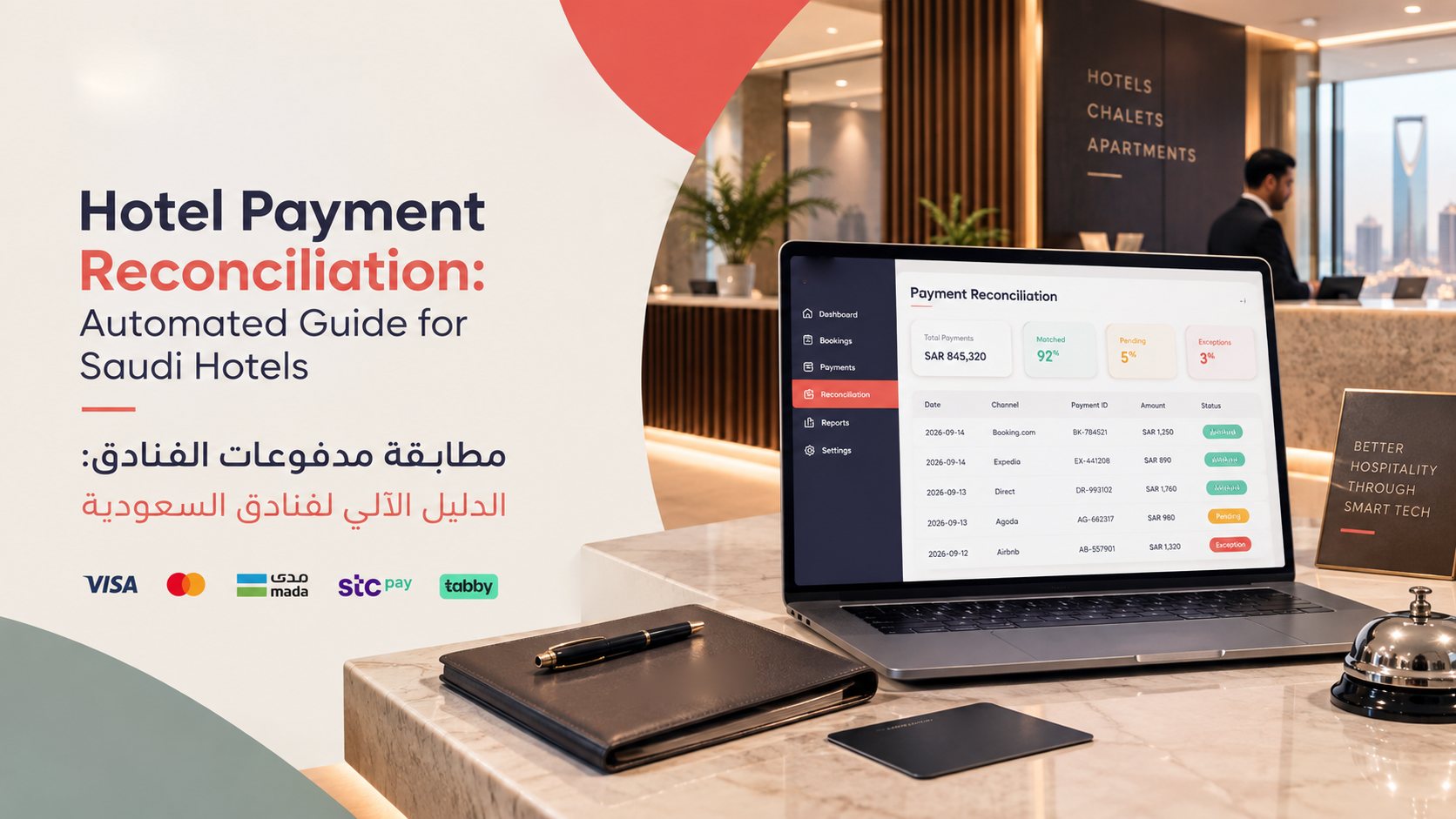
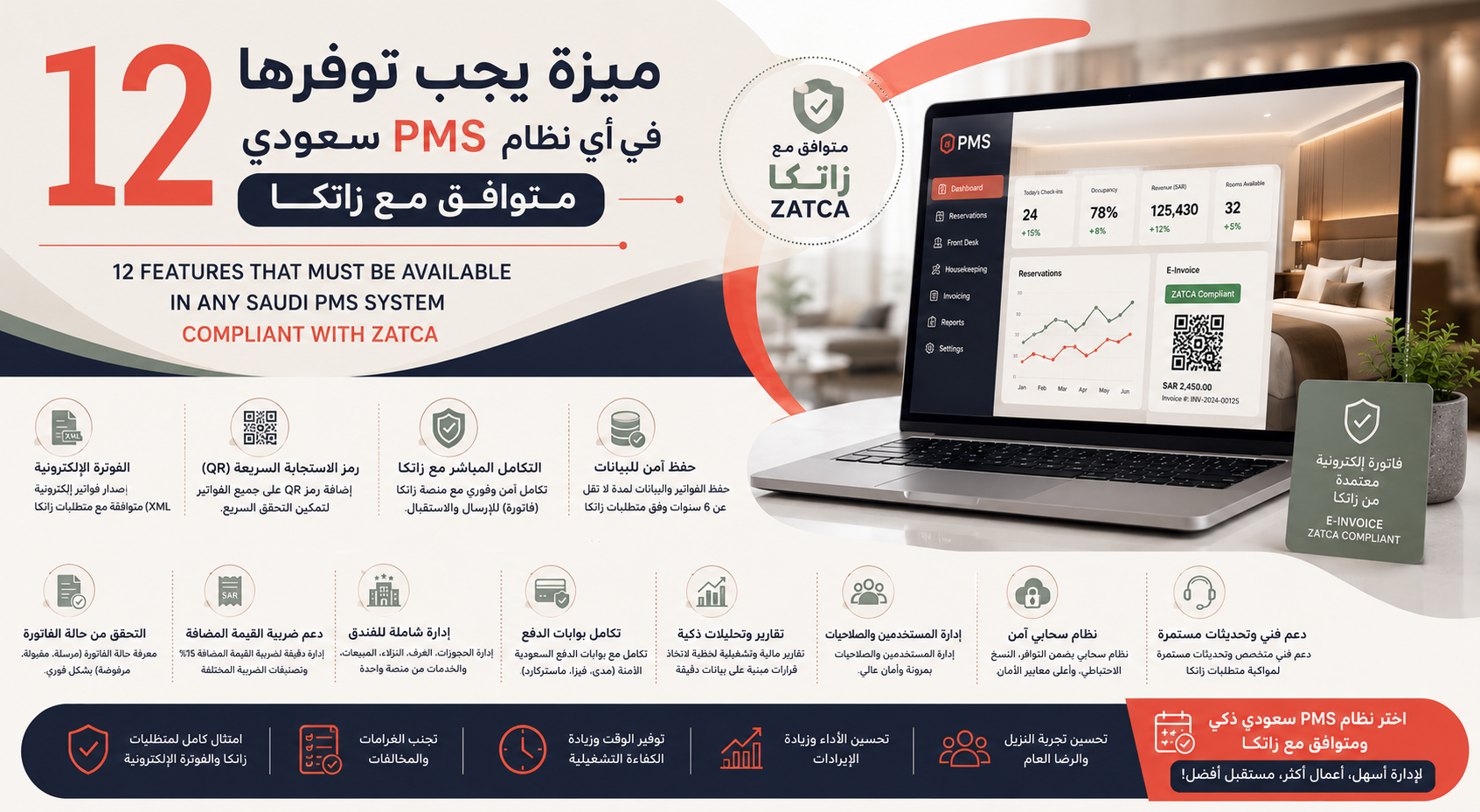
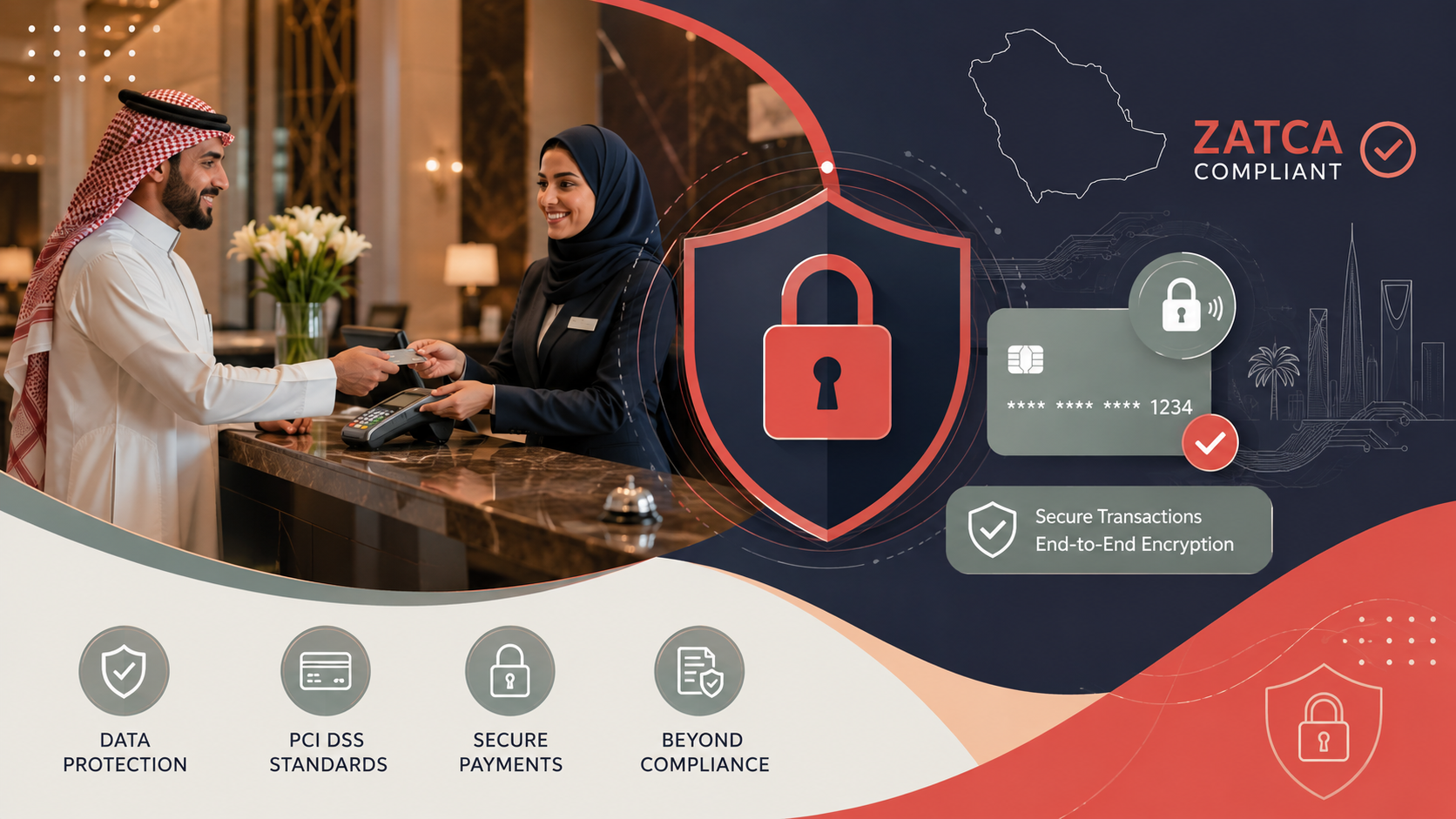
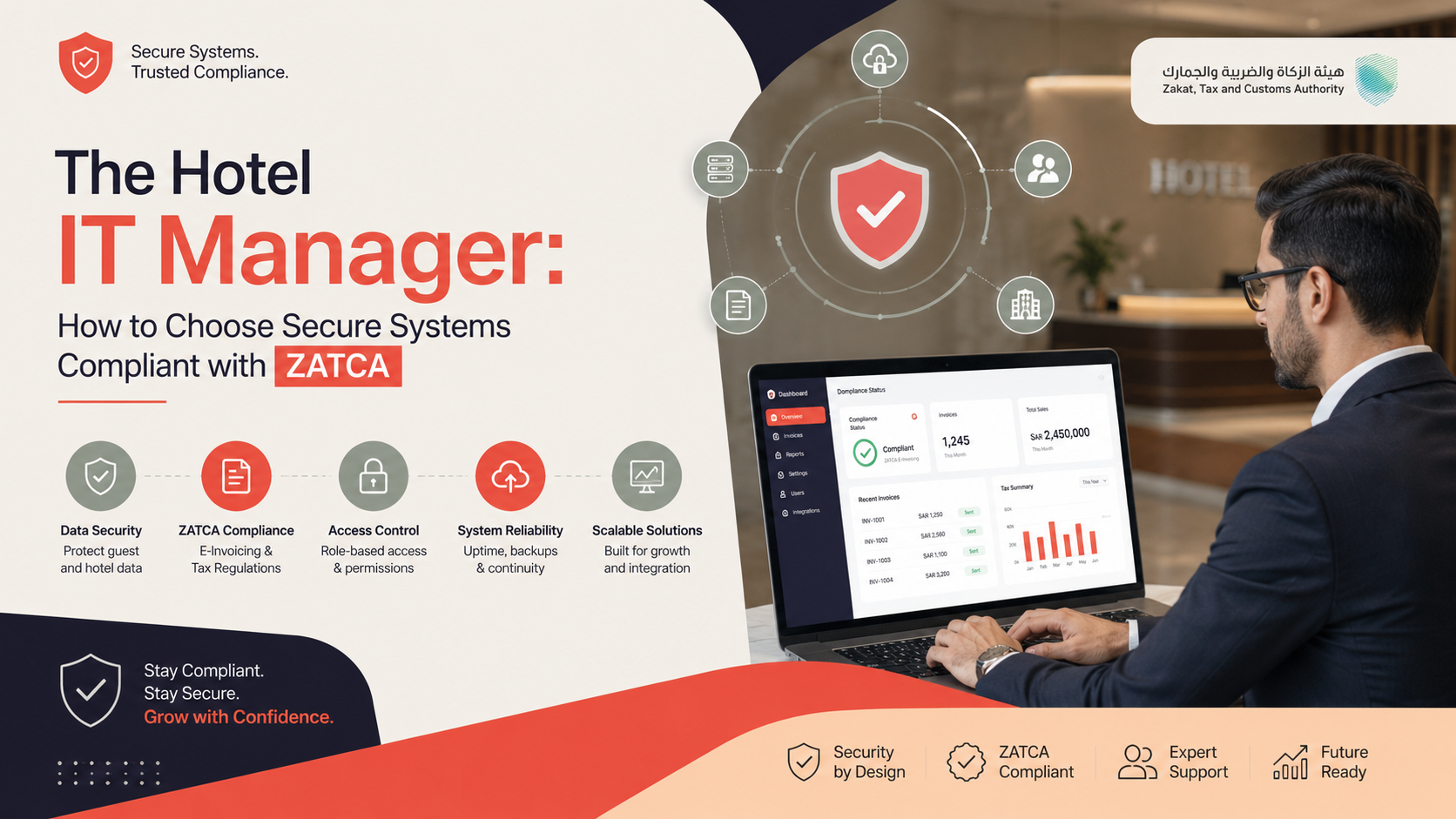
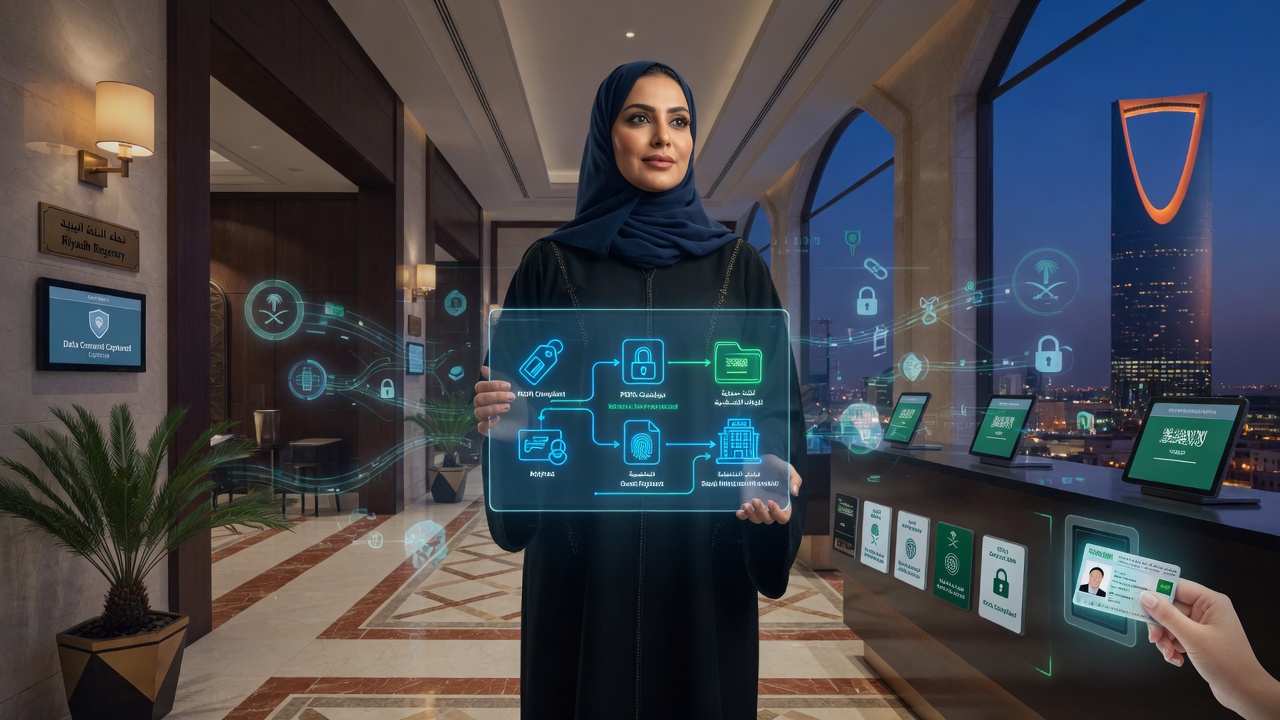
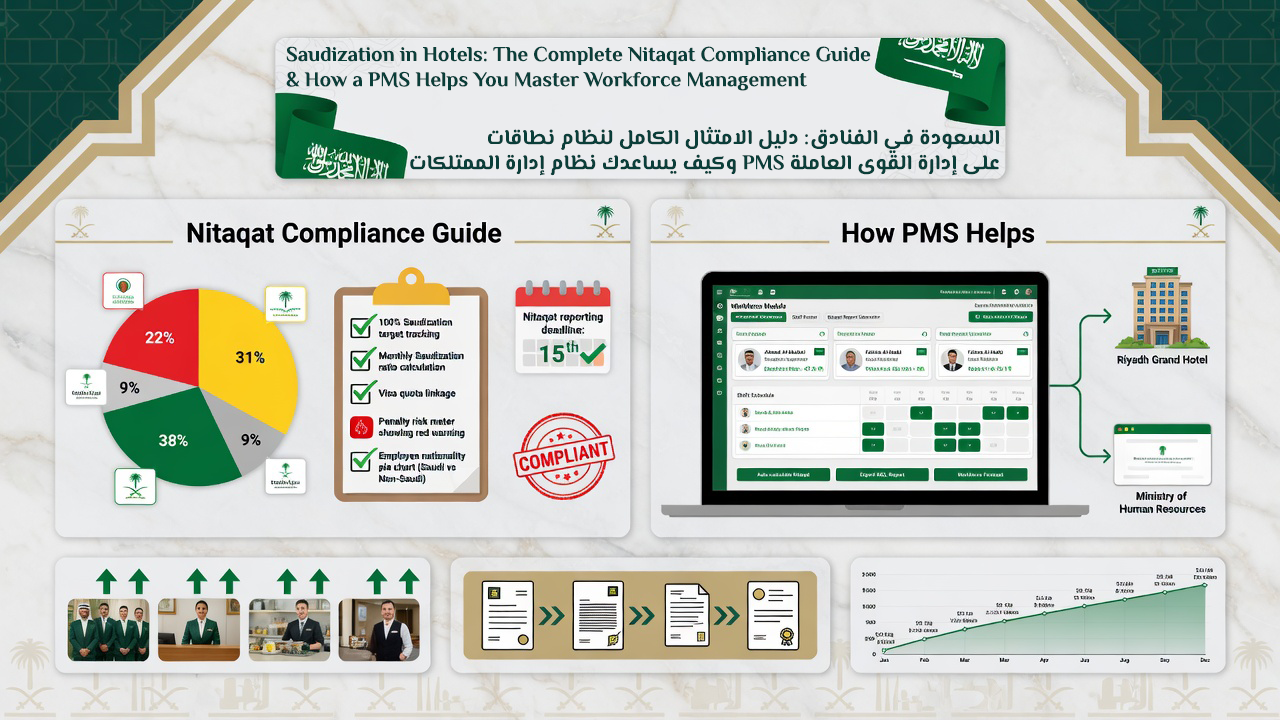
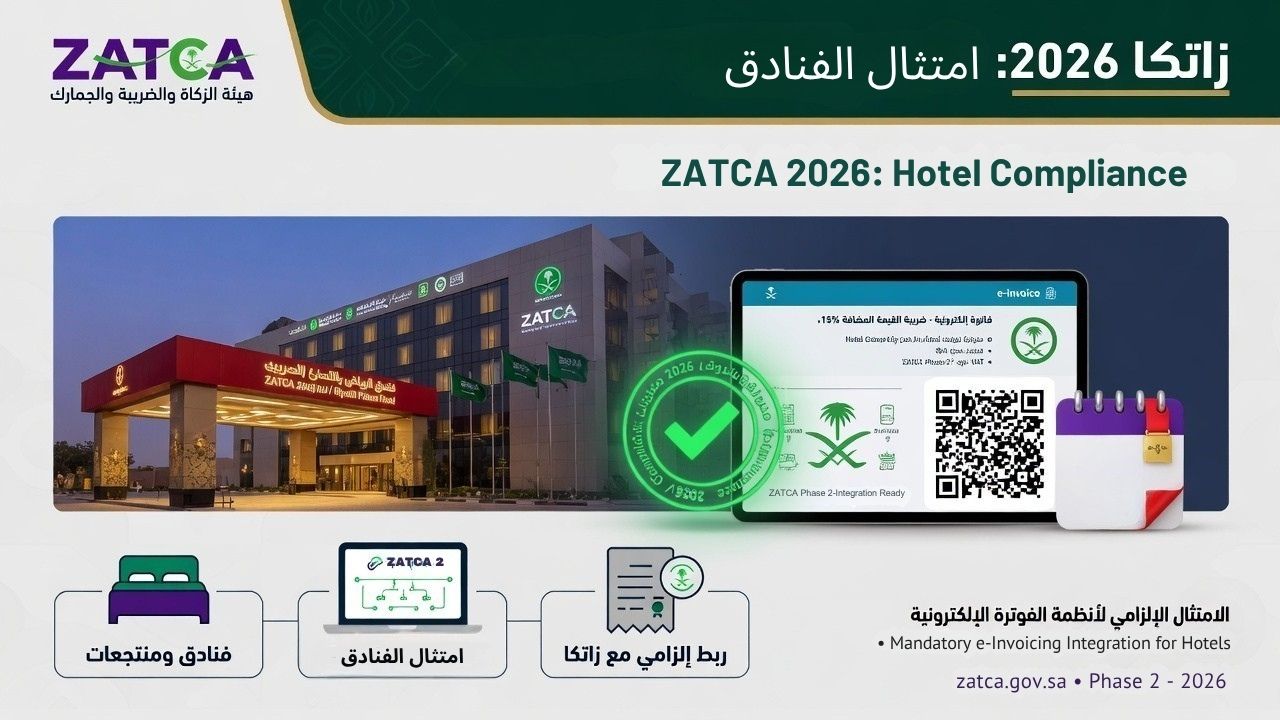
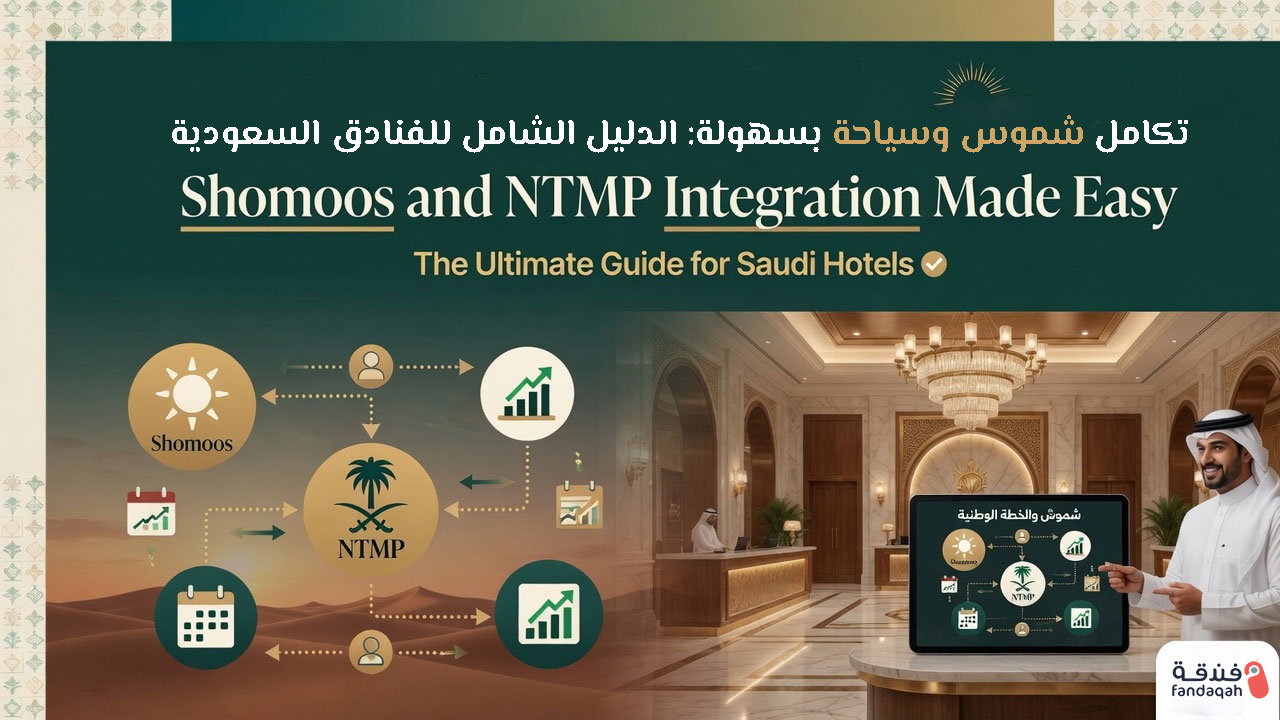
Saudi hotel groups may also need technology that supports local operational and regulatory requirements. Depending on the property and operating model, this can include connections involving the Ministry of Tourism, Shomoos, ZATCA, payment services, online booking channels, Arabic guest communication, and other local requirements.
Saudi-Specific Evaluation Checklist
- Does the PMS support the required Saudi regulatory integrations?
- Can different properties operate with appropriate local configurations?
- Can the group manage Arabic and English workflows?
- Can rates and availability connect to relevant local and international channels?
- Can management see property-level and portfolio-level information?
- Can the system support future expansion into hotels, serviced apartments, resorts, or chalets where relevant?
Three Realistic Scenarios for a Growing Saudi Hotel Group
Scenario 1: Three Hotels Under One Management Team
A group operates three properties in different Saudi cities. Each property has its own PMS, while finance uses spreadsheets to consolidate monthly figures. Revenue managers spend time comparing room rates and occupancy manually.
At this stage, the group may still function, but the technology is creating coordination work. A multi-property PMS becomes relevant when centralized reporting, shared revenue processes, and portfolio visibility become daily requirements rather than occasional conveniences.
Scenario 2: A Hotel Group Adds Serviced Apartments
The group expands beyond traditional hotel rooms into serviced apartments. Suddenly, inventory structures, longer stays, different cleaning patterns, and guest communication workflows become more complex.
The important requirement is not simply “more rooms.” It is the ability to manage different accommodation models under a coherent operating environment.
Scenario 3: Expansion Is Planned Before the Current Property Stack Breaks
This is often where technology strategy matters most. The group has two hotels today but plans to add several more. Waiting until every manual process becomes painful may make migration harder because data, integrations, workflows, and staff habits have already become deeply fragmented.
An early assessment lets the group design a repeatable technology template for future properties rather than reacting to every opening independently.
Documented Industry Evidence: What Large Hotel Groups Are Doing
The move toward centralized cloud hospitality platforms is not purely theoretical. In September 2025, Oracle announced that Accor was moving its global properties toward Oracle OPERA Cloud. Oracle described the objective as creating a common PMS platform that can standardize information across individual properties and the wider portfolio.
In March 2026, Oracle also announced that Motel One had migrated its hotel portfolio to OPERA Cloud, covering more than 100 properties across 13 countries. Oracle described the resulting common data and operational foundation as supporting efficiency, innovation, and service delivery.
These examples do not mean every regional or independent hotel group needs enterprise software of the same scale. They do show the operational principle clearly: as portfolios become larger, standardized data and connected hotel operations become strategically important.
Evidence note: The Accor and Motel One examples are vendor-reported announcements from Oracle and describe specific enterprise implementations. They should be treated as documented case evidence, not as proof that every hotel group will achieve identical results.
Multi-Property PMS vs CRS vs Channel Manager
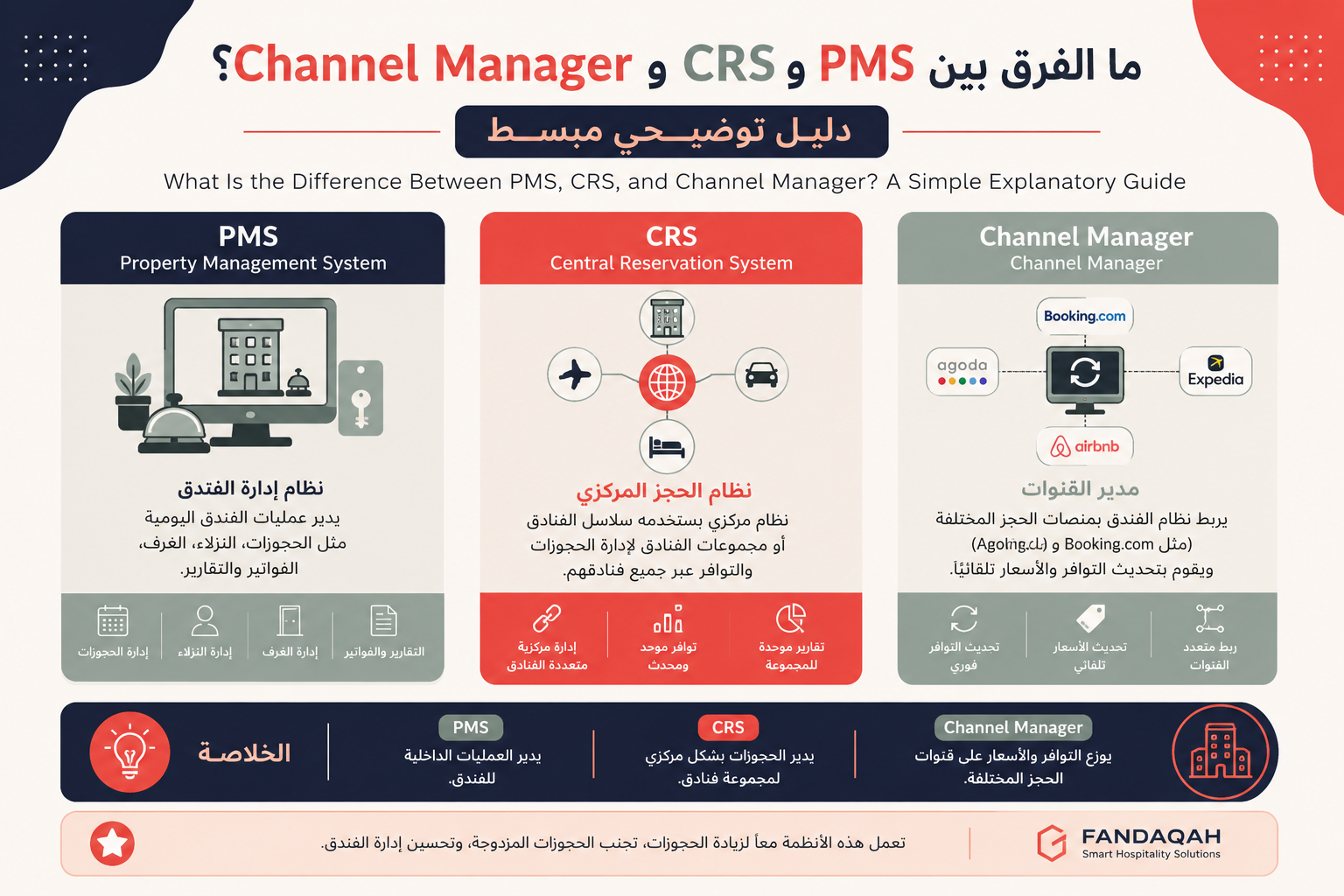
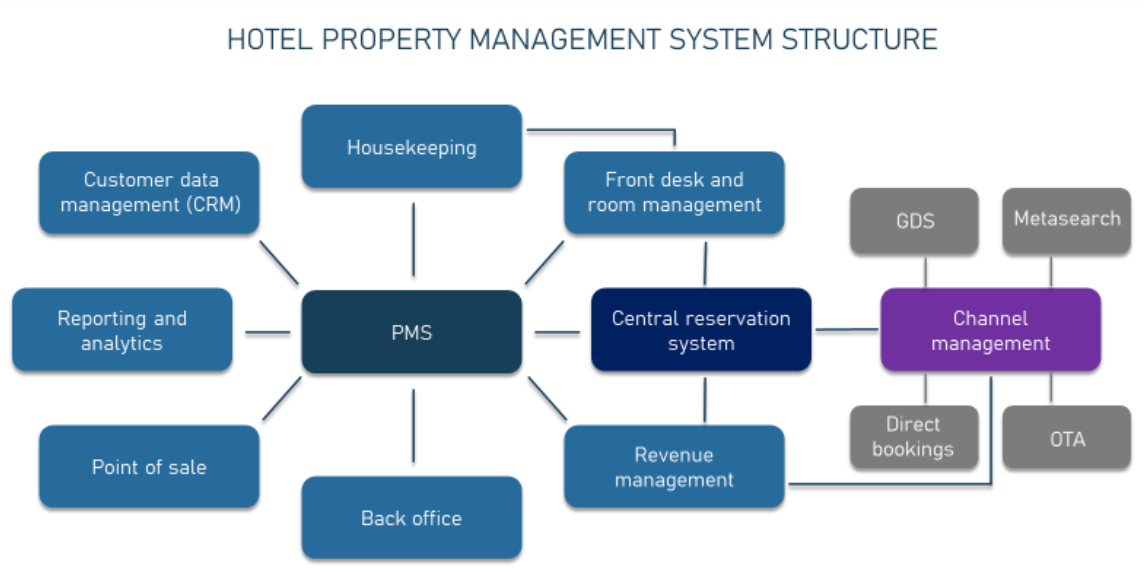
One source of confusion is assuming that PMS, Central Reservation System, and Channel Manager are interchangeable. They are related, but they solve different problems.
| System | Primary Role | Why a Group Uses It |
|---|---|---|
| PMS | Daily property operations | Reservations, rooms, check-in, check-out, housekeeping, reports |
| Multi-Property PMS | Operations across several properties | Central visibility, shared controls, standardized processes, portfolio reporting |
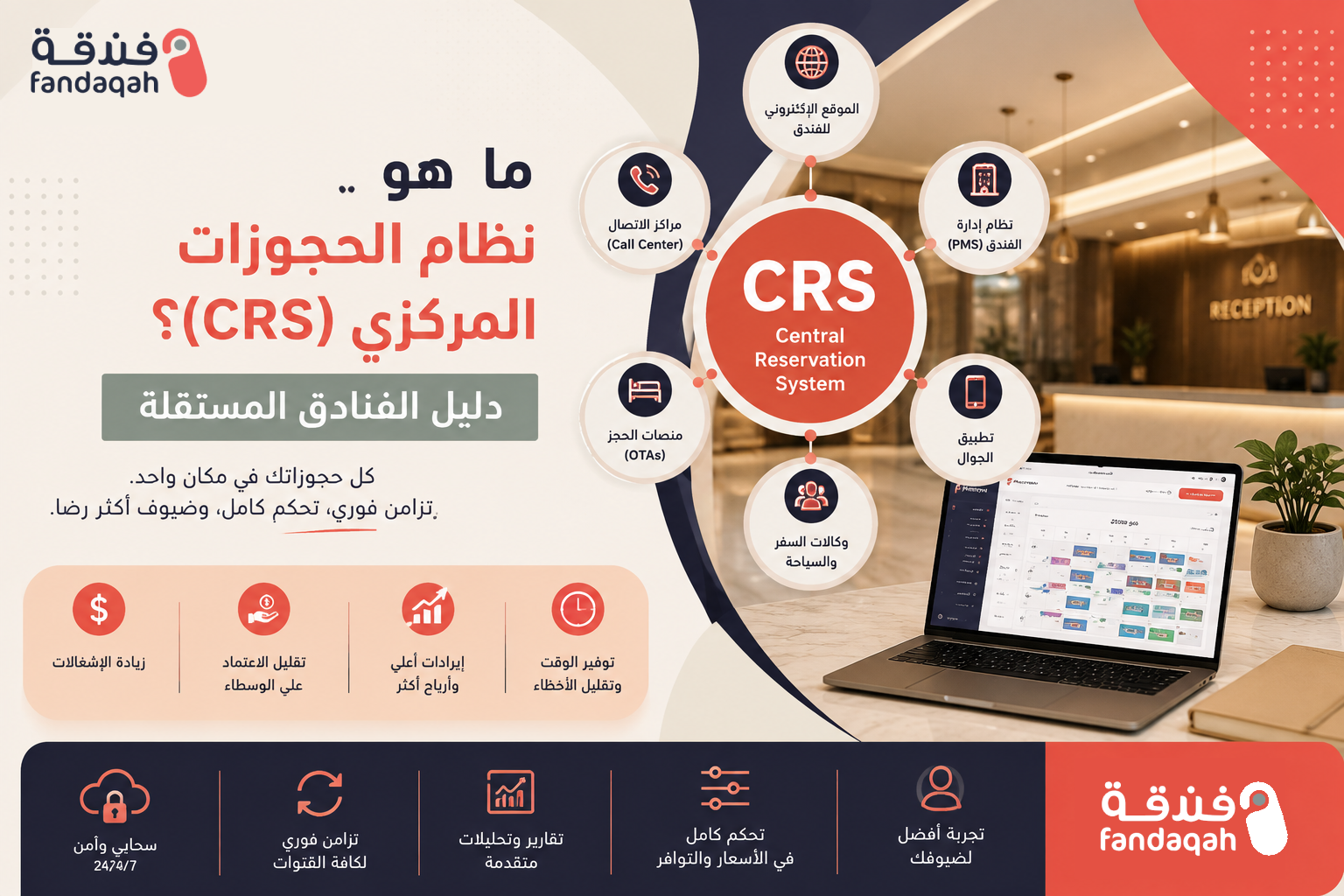
| CRS | Central reservation management | Centralized reservation demand and inventory distribution across properties |
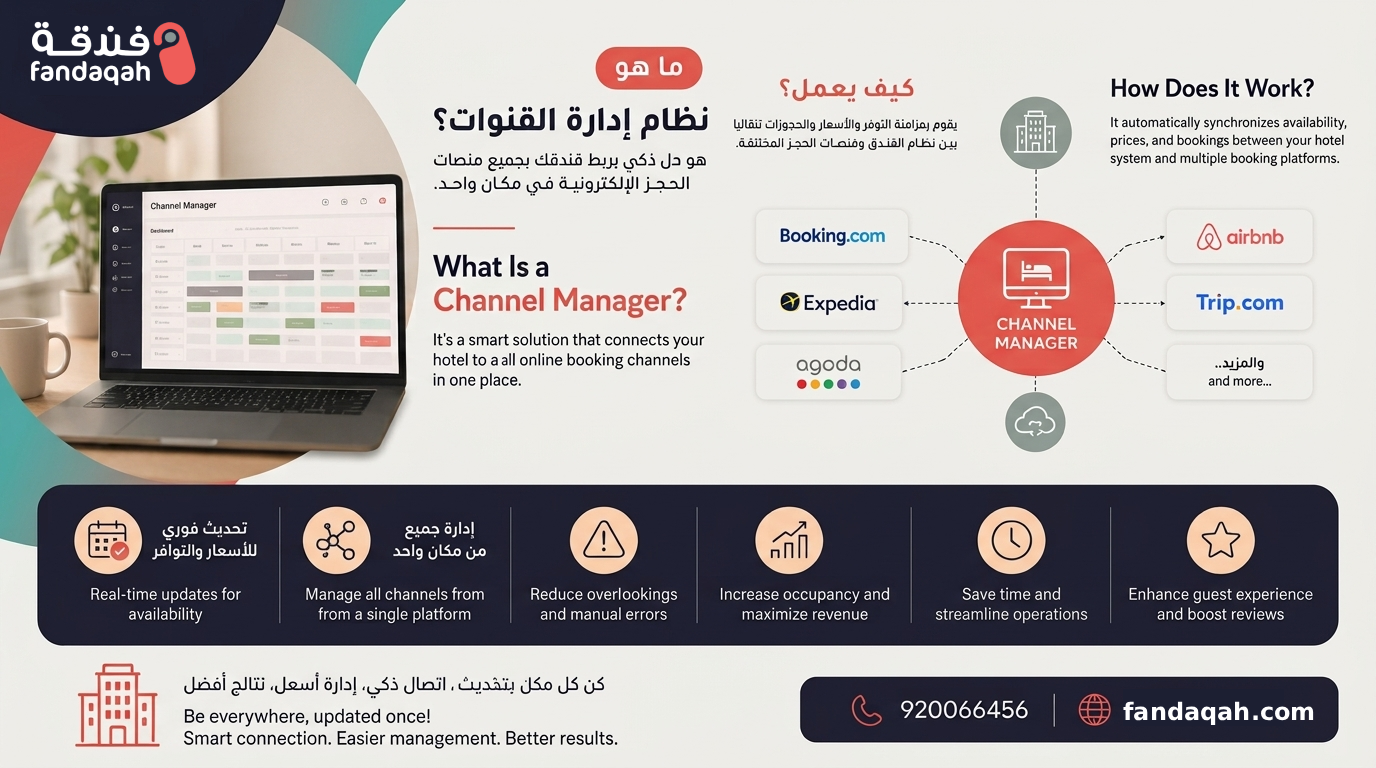
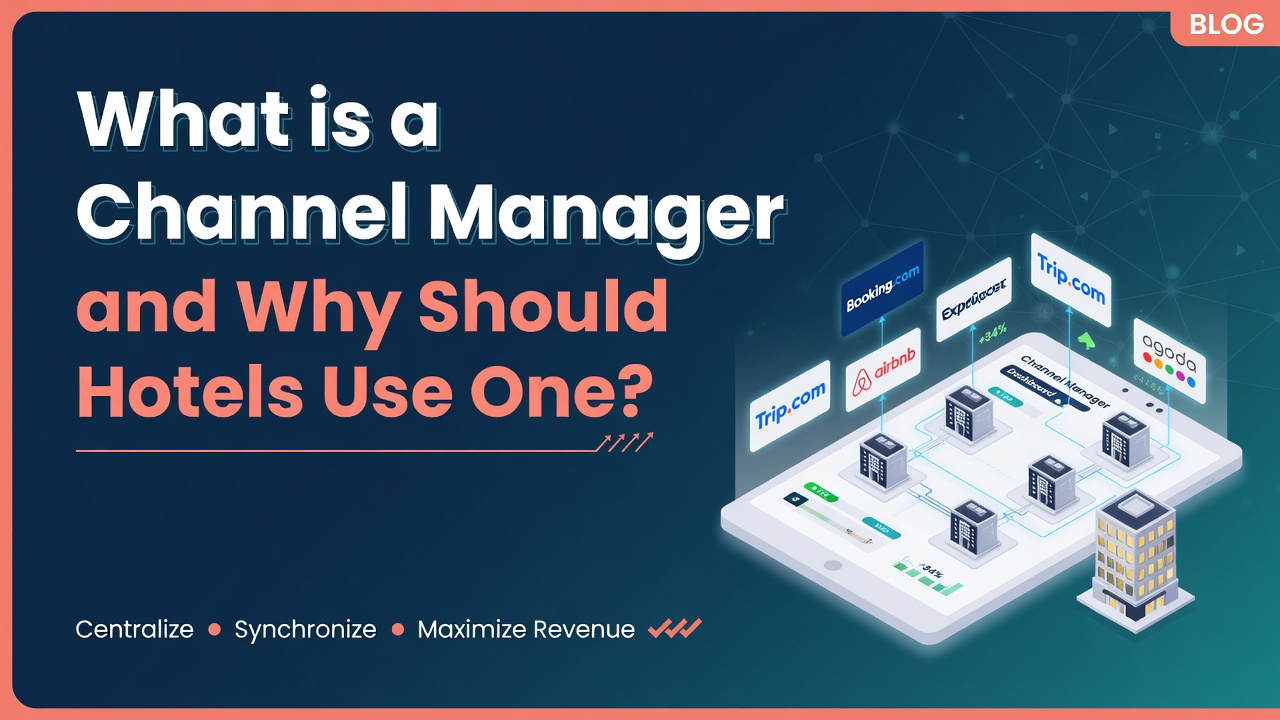
| Channel Manager | Distribution synchronization | Connects rates and availability with booking channels |
In a mature technology stack, these systems may work together rather than compete with one another. The exact architecture depends on the size of the group, its distribution model, brand structure, finance systems, and required integrations.
What Should a Growing Hotel Group Look for in a Multi-Property PMS?
1. Cloud Architecture
A cloud PMS can make authorized information accessible without tying management to a single property's local infrastructure. Fandaqah publicly describes its platform as cloud-based and accessible from different locations, with backups and technical support.
2. Centralized Reporting
Portfolio growth creates a need for consistent KPIs. Ask whether reports can be viewed at property level and consolidated at management level without extensive spreadsheet manipulation.
3. Strong Channel Connectivity
A multi-property operating model becomes more valuable when the PMS connects effectively with relevant booking channels. Fandaqah publicly describes a Channel Manager that synchronizes rates and availability and supports multi-channel management.
4. Saudi Compliance Connectivity
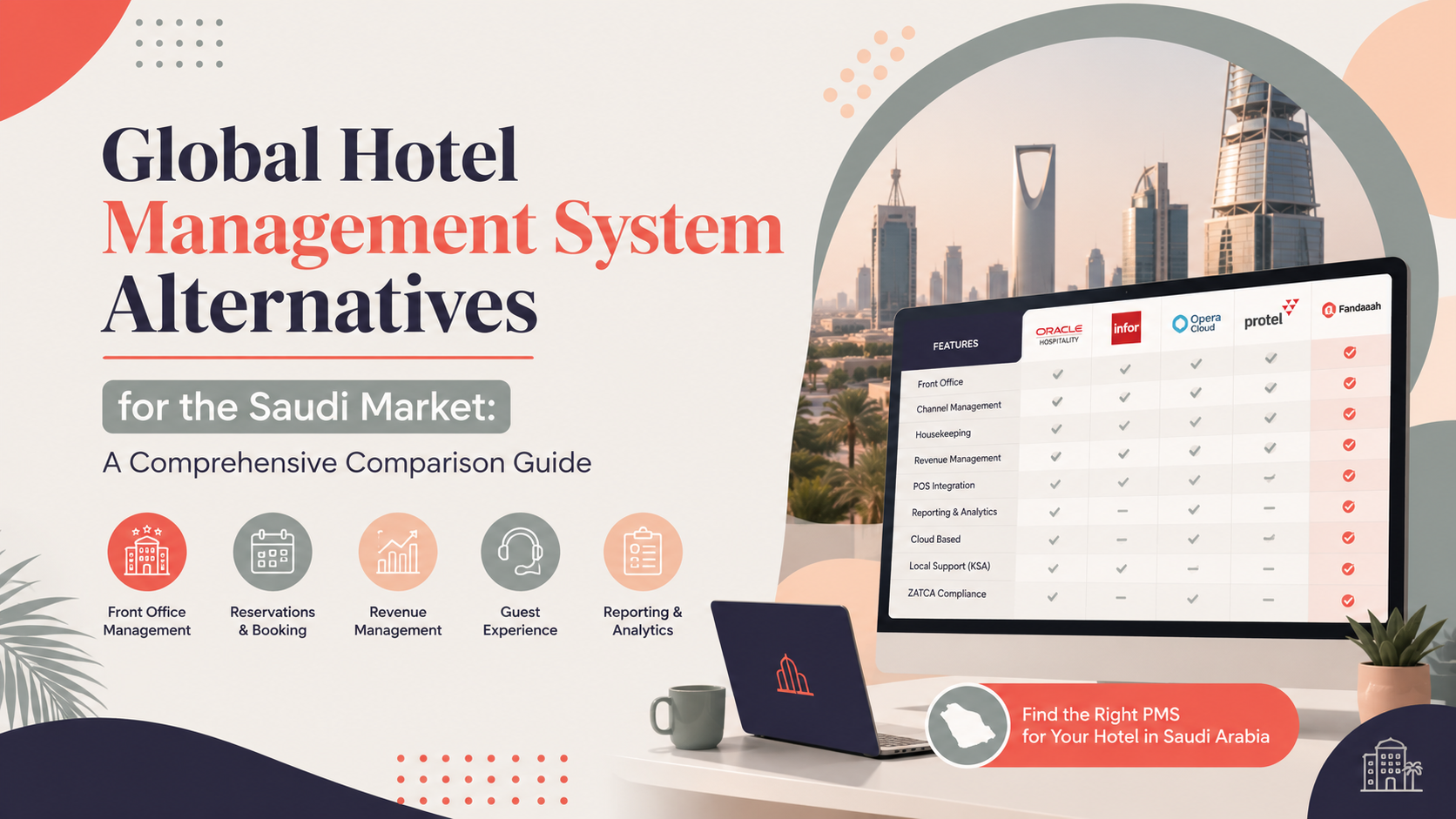
Fandaqah publicly lists integrations involving ZATCA, Shomoos, and tourism-related systems. For Saudi hotel operators, local integration capability should be part of the PMS evaluation rather than treated as an optional afterthought.
5. Booking Engine and Direct Distribution
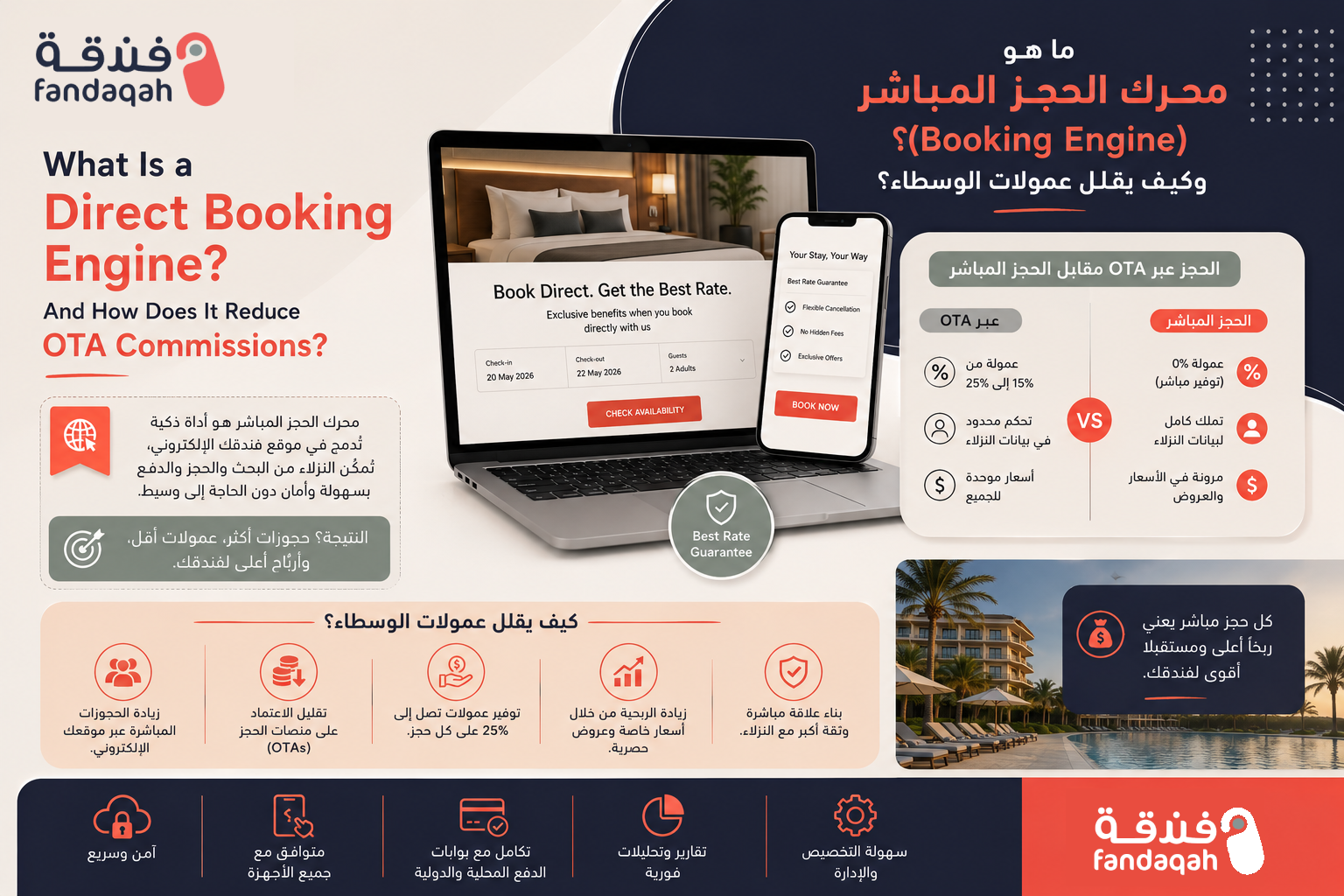
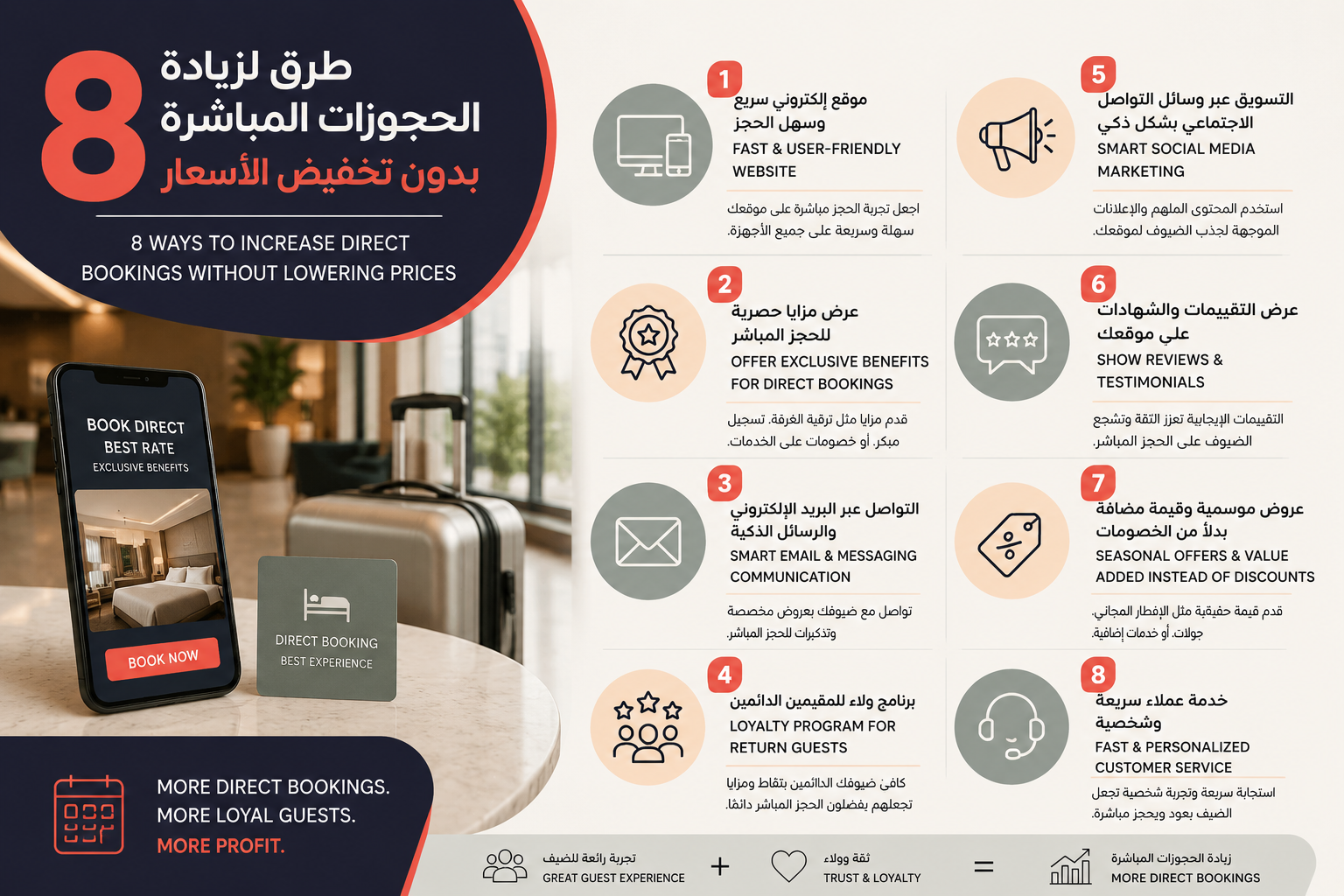
Owning multiple properties also increases the importance of direct booking strategy. Fandaqah publicly offers a website and booking engine positioned for direct reservations, multilingual support, and search optimization.
6. Permissions and Property-Level Controls
Centralization should not mean every employee can see or change everything. A serious multi-property architecture should provide appropriate controls for corporate teams, property managers, front-office users, finance, reservations, and other roles.
7. Migration and Onboarding Support
Software capability alone is not enough. Ask about data migration, staff training, configuration, integration testing, go-live support, and rollback planning before signing a long-term contract.
Fandaqah: Product Evidence Relevant to Growing Saudi Operators
Fandaqah positions itself as a cloud hospitality platform for hotels and other accommodation businesses in Saudi Arabia. Its public product information describes a combination of PMS, Channel Manager, website and booking engine capabilities, together with integrations for ZATCA, Shomoos, tourism-related systems, and local and global booking channels.
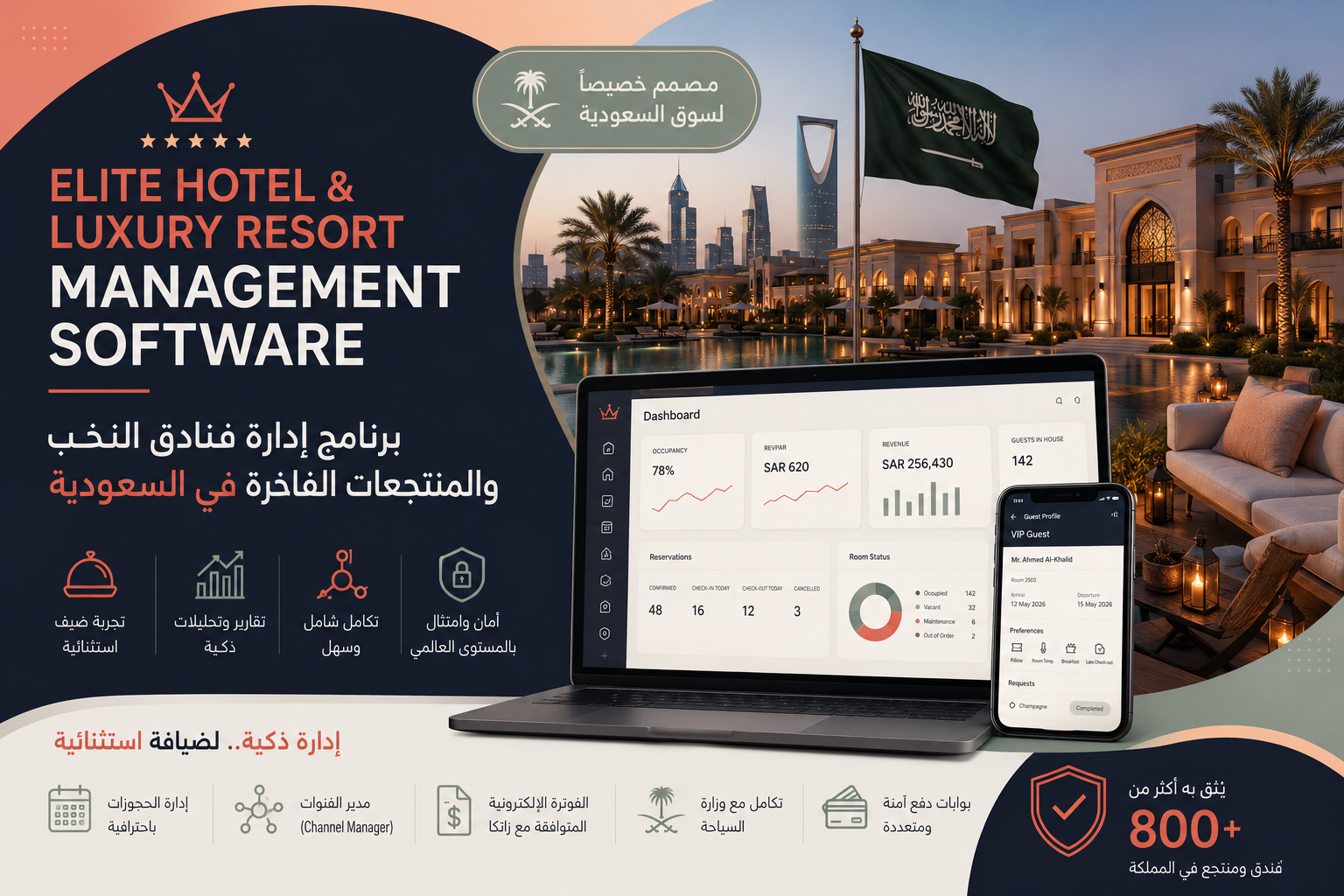
Fandaqah's public website currently states that the platform is trusted by 800+ hotels. Because this is a company-reported figure, it should be treated as vendor-reported evidence rather than an independently audited market statistic.
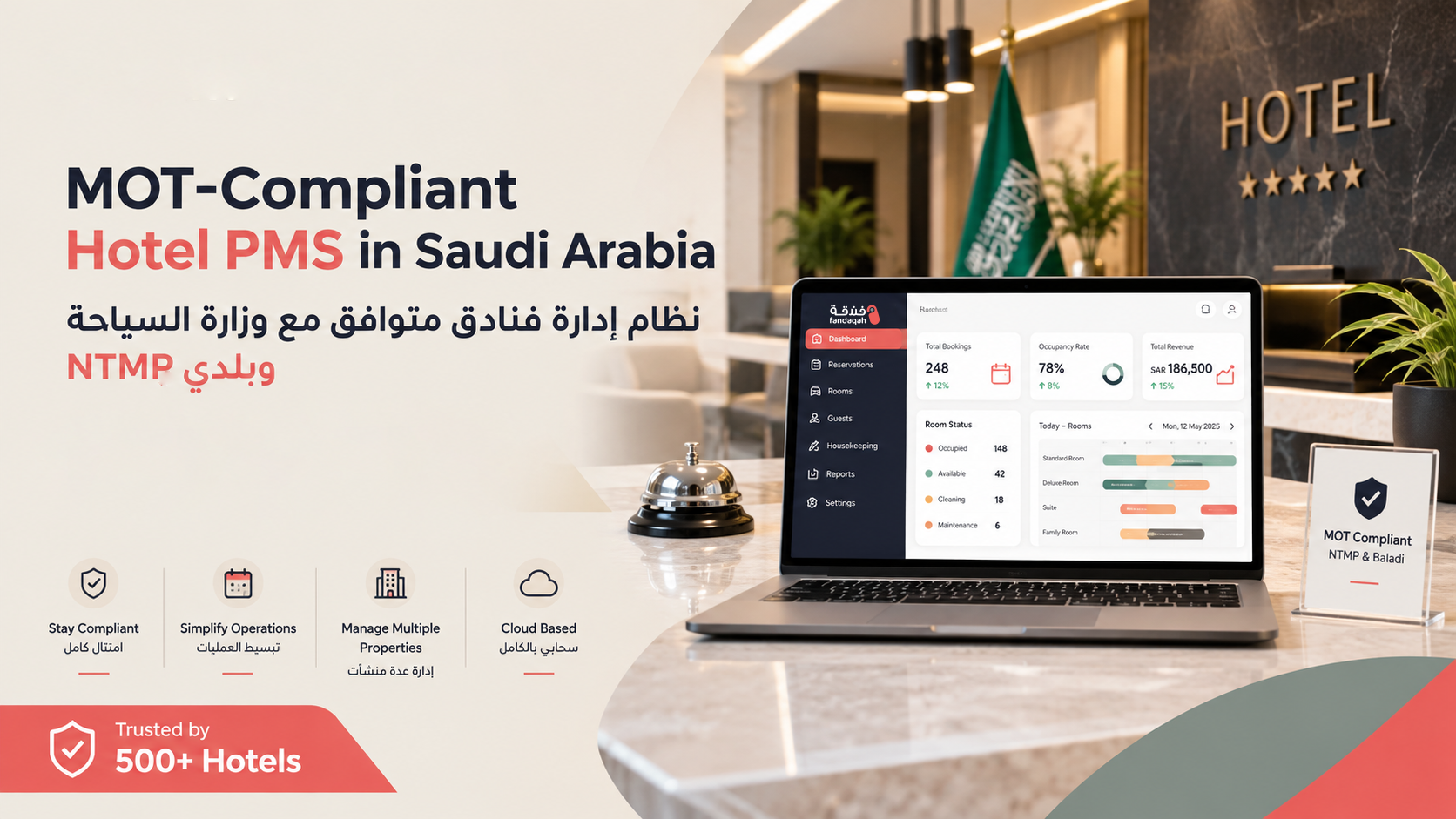
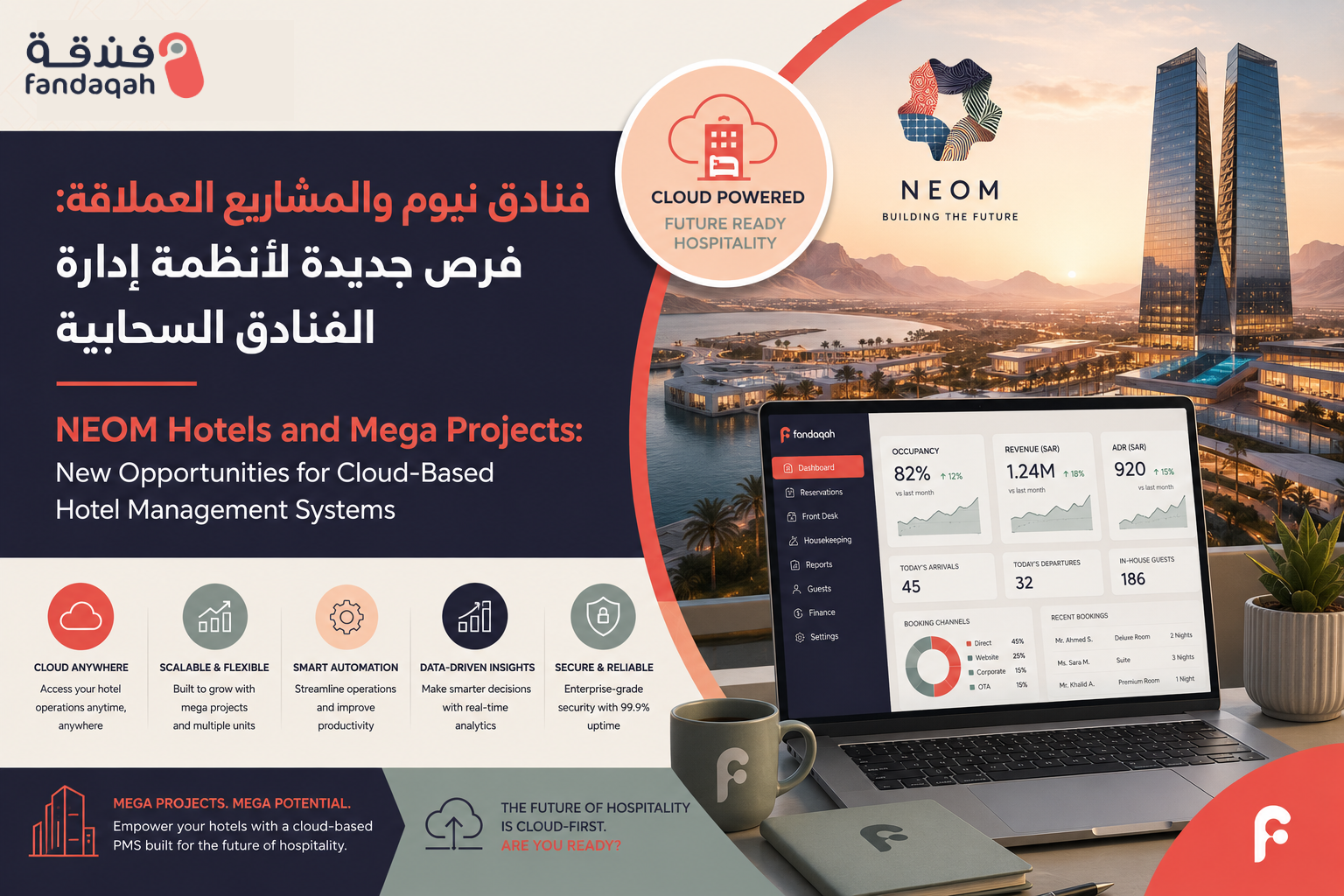
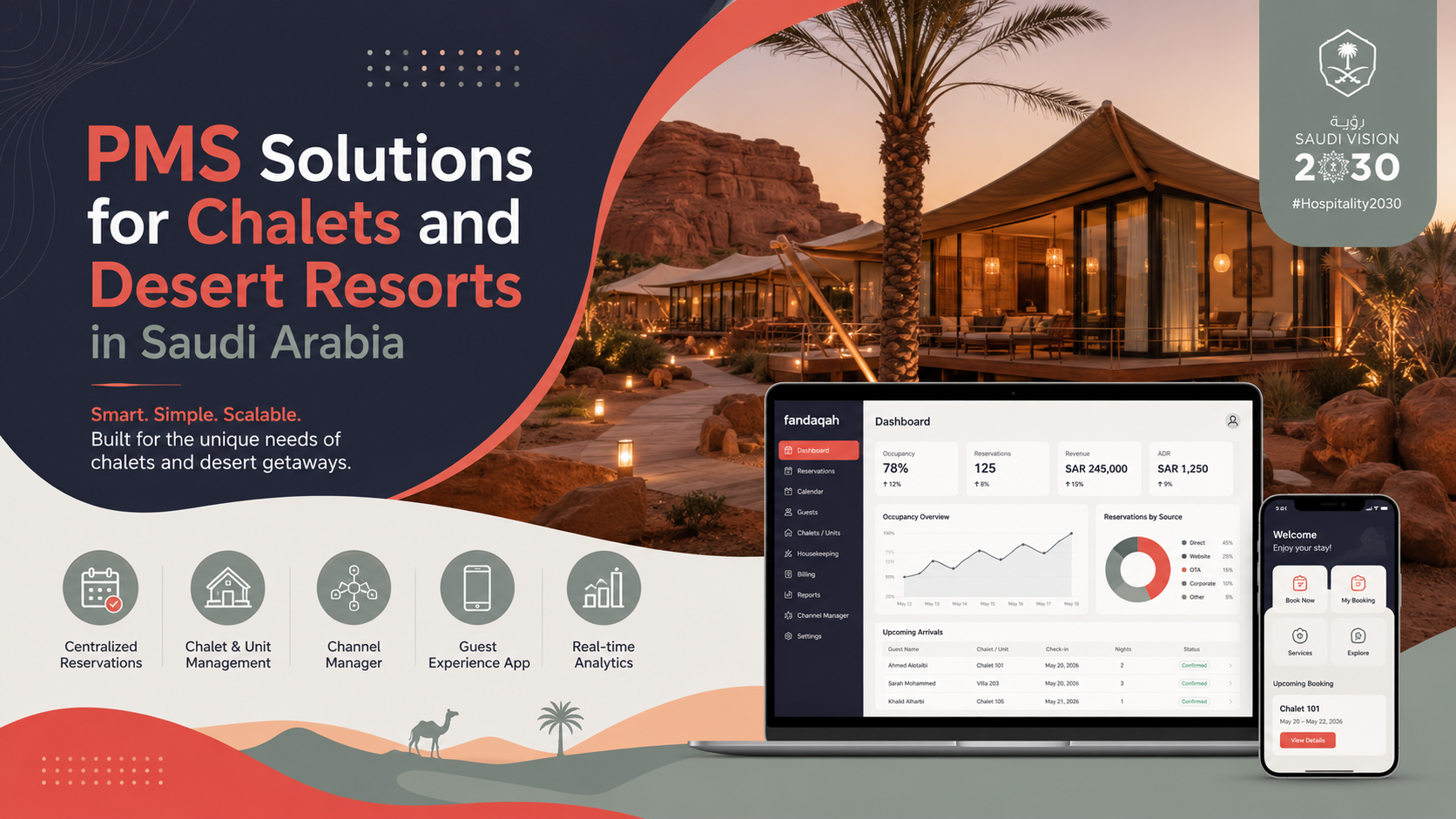
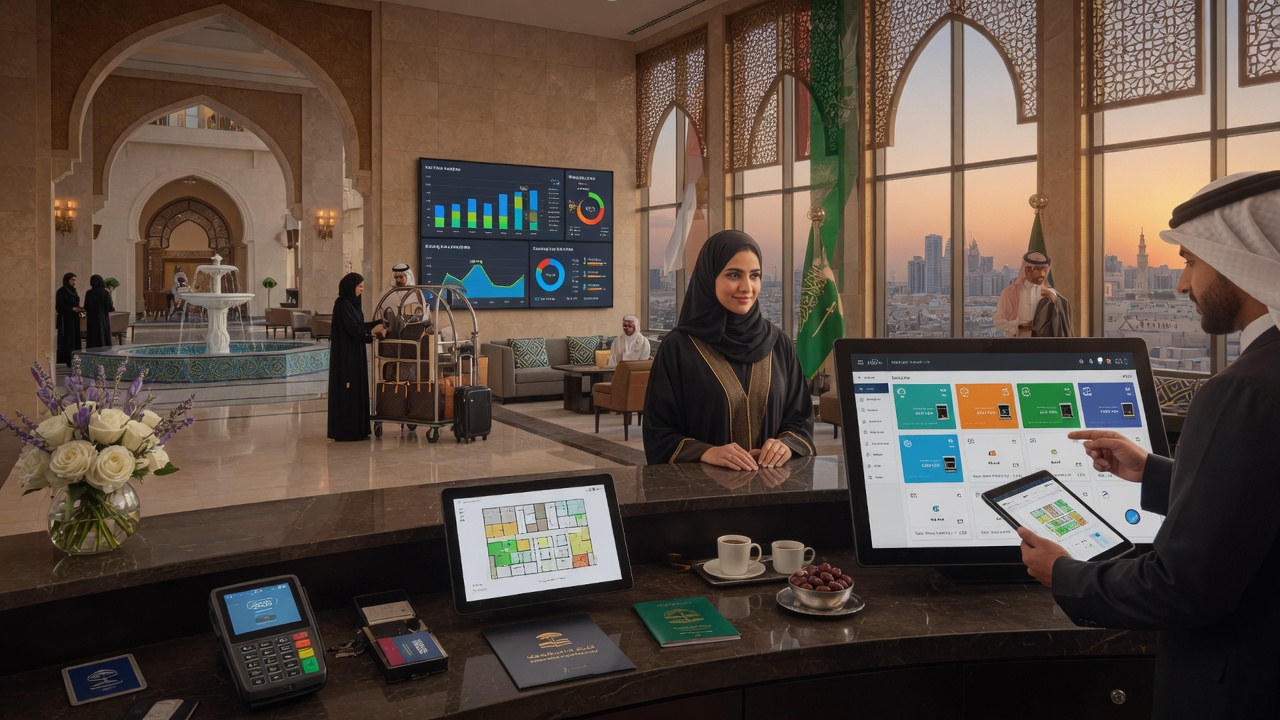
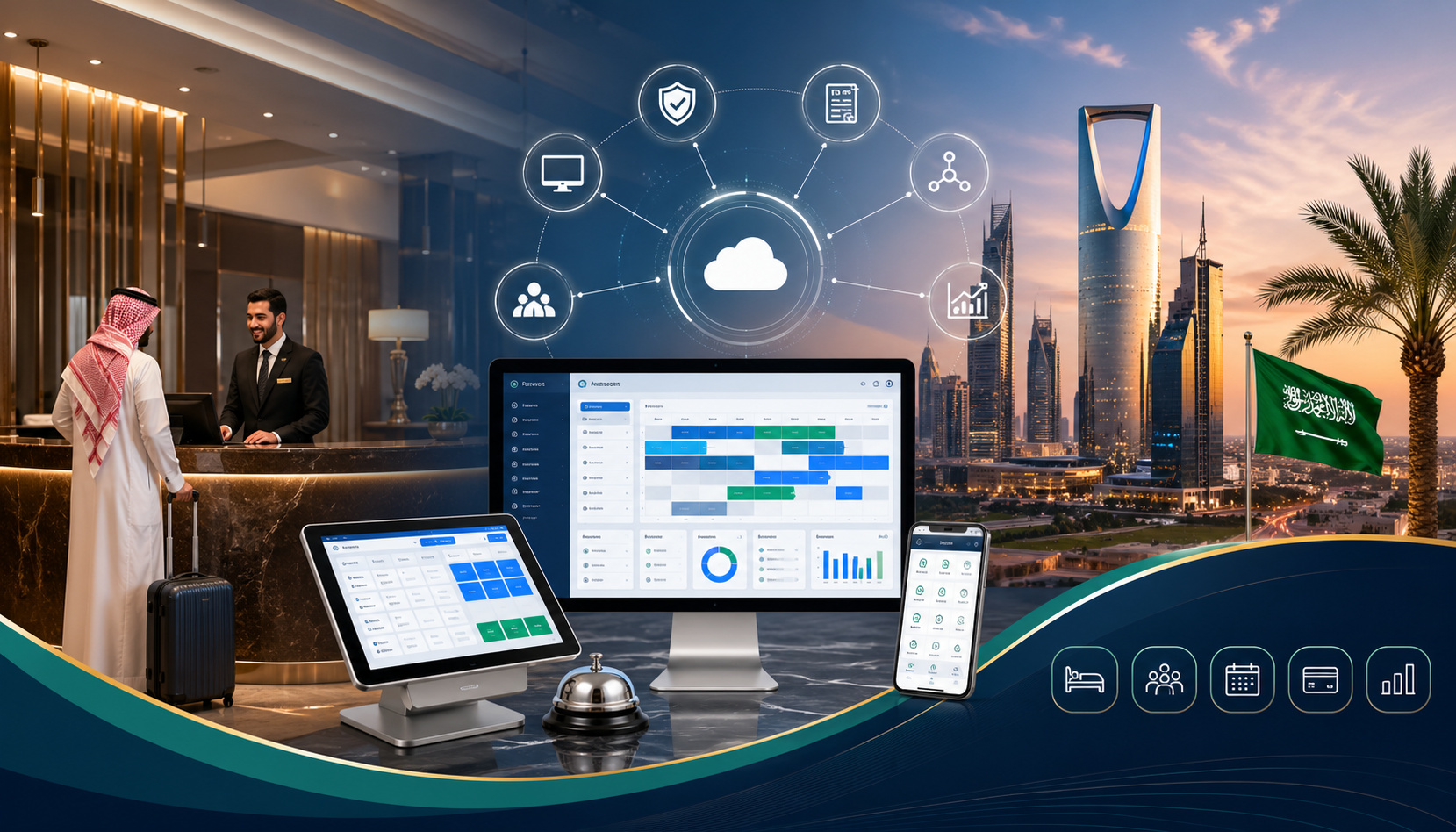
The platform also publicly describes dashboards for operational information such as occupancy, arrivals, departures, room status, booking management, room service and reporting. Its feature documentation additionally describes centralized guest communication, analytics, payment options, accounting integrations, and multi-property management use cases.
Why This Matters for a Saudi Hotel Group
For a growing operator, the question is not simply whether a PMS can manage reservations. The broader question is whether the technology can support the complete growth journey: property operations, distribution, direct bookings, reporting, local integrations, guest communications, and expansion into additional properties.
Fandaqah's product evidence should still be assessed against your specific portfolio requirements. A group evaluating any PMS should request a live demonstration using its actual property structure, room categories, rate plans, OTA mix, accounting process, compliance requirements, and reporting expectations.
A Practical PMS Readiness Test
Before migrating, ask your team these questions:
- Can we produce a consolidated portfolio report without manually combining property spreadsheets?
- Can we update rates and availability without repeating the same task across many systems?
- Can management compare properties using consistent definitions and KPIs?
- Can a guest's relationship with the group be understood across multiple stays where appropriate?
- Can we add a new property without rebuilding the technology stack from zero?
- Can our PMS support required Saudi integrations?
- Can finance and operations trust the same underlying data?
- Can we maintain property-level flexibility while establishing group-wide standards?
If several answers are “no,” your organization may already be experiencing the operational consequences that a multi-property PMS is intended to address.
When You Should Not Rush the Migration
Centralization is not automatically better in every situation.
A hotel group should carefully evaluate migration when its properties are genuinely independent, management reporting is already efficient, the current systems integrate well, and there is little duplication. Migration also carries risks if the implementation team does not understand hotel workflows or if the group attempts to change every operational process at the same time.
The correct objective is not “replace the old PMS as quickly as possible.” The objective is to create a technology environment that reduces complexity rather than moving complexity from one system into another.
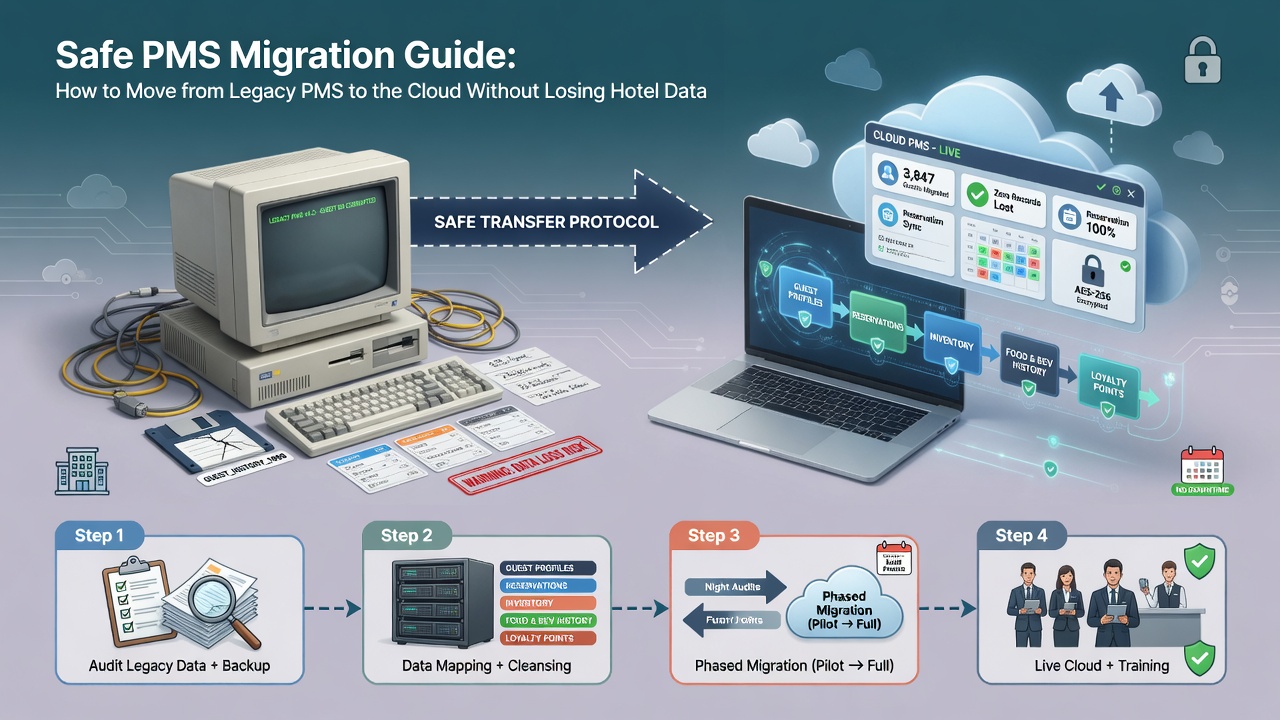
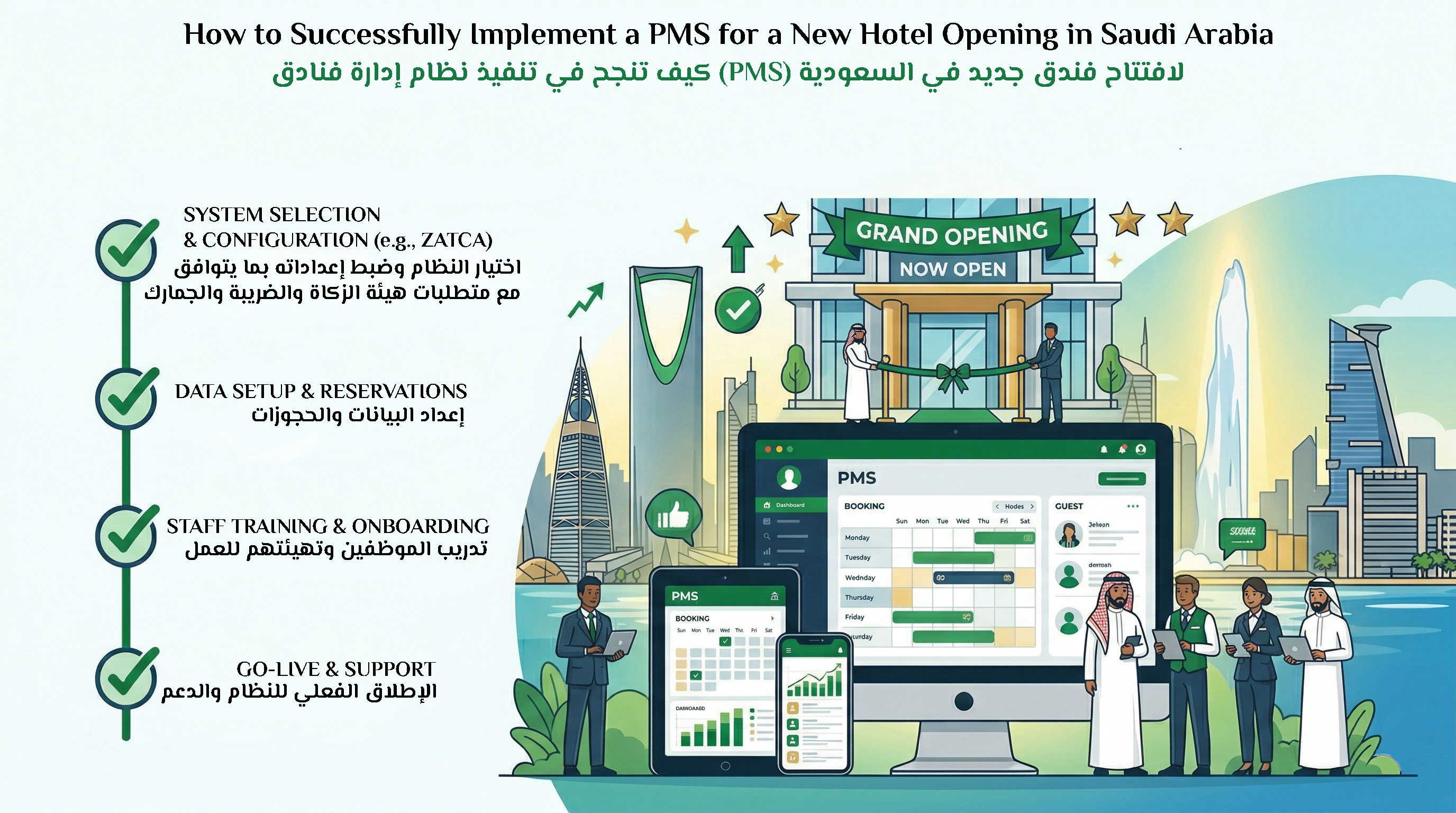
How to Build a Successful Migration Plan
Phase 1: Map the Existing Portfolio
Document every property, room type, rate plan, booking channel, payment provider, accounting connection, reporting workflow, user role, and regulatory integration.
Phase 2: Define Group Standards
Decide which processes should become standardized and which should remain property-specific. This is one of the most important decisions in a multi-property implementation.
Phase 3: Build a Data Migration Plan
Decide which guest profiles, reservations, room information, financial data, and historical records need to move. Test the migration before the production cutover.
Phase 4: Pilot One Property
A pilot can reveal workflow problems before the group performs a full rollout. Choose a property that is representative enough to test the intended model without making the first deployment unnecessarily complex.
Phase 5: Train Central and Property Teams
Training should cover both “how to use the software” and “how the group's new operating model works.” A powerful PMS cannot compensate for unclear processes.
Phase 6: Roll Out in Controlled Waves
After the pilot, migrate properties in manageable stages. Maintain a clear issue-management process and monitor operational KPIs throughout the transition.
Future Trends: Why the Multi-Property Decision Will Matter Even More
The next generation of hotel technology is moving beyond simple reservation management. Cloud architecture, predictive analytics, automated distribution, AI-assisted guest communication, mobile operations, integrated payments, digital experiences, and smarter revenue tools are increasingly becoming part of the hotel technology conversation.
For hotel groups, the strategic importance is the data layer connecting these capabilities. The more disconnected the portfolio becomes, the harder it is to use information consistently across properties.
Saudi Arabia's tourism strategy makes this particularly relevant. The Ministry of Tourism currently identifies a 150-million-tourist target by 2030, while Vision 2030 reporting highlights the Kingdom's continued expansion as a tourism destination. A scalable hospitality technology foundation can therefore become part of the infrastructure supporting portfolio growth rather than merely an administrative application.
AI is another reason to think about architecture before scale. Automated forecasting, dynamic pricing, guest messaging, demand analysis, and operational recommendations depend on reliable and structured data. Fragmented hotel systems can make that data harder to use consistently.
FAQ: Multi-Property PMS for Growing Hotel Groups
When should a hotel group use a multi-property PMS?
A hotel group should seriously evaluate a multi-property PMS when separate property systems create duplicated work, fragmented reporting, inconsistent processes, limited management visibility, distribution complexity, or problems scaling to additional properties. The trigger is operational complexity rather than a fixed number of hotels.
How many hotels do I need before buying a multi-property PMS?
There is no universal minimum. A group with two properties and a centralized management team may benefit sooner than a larger portfolio where every hotel operates independently. Evaluate the volume of shared management, reporting, reservations, distribution, finance, and guest data.
What is the difference between a multi-property PMS and a CRS?
A multi-property PMS focuses on hotel operations across several properties. A CRS focuses primarily on central reservation management and inventory distribution across properties. Some hotel groups use both as complementary systems.
Can a multi-property PMS manage hotels in different Saudi cities?
Yes, a properly designed cloud-based platform can support geographically distributed properties. During evaluation, confirm that the platform supports your specific property structures, permissions, integrations, reporting requirements, and local operating needs.
Does a multi-property PMS reduce manual hotel reporting?
It can, particularly when the PMS provides centralized reporting and consistent data structures. The amount of improvement depends on implementation quality, report design, integrations, and the processes being replaced.
Can a multi-property PMS work with OTAs and direct bookings?
Many modern PMS environments connect with channel-management and booking-engine capabilities. The exact channels supported vary by provider, so a hotel group should test its required OTA, direct-booking, payment, and distribution workflows before selecting a platform.
What should Saudi hotels check before choosing a PMS?
Check local regulatory connectivity, channel integrations, payment options, Arabic support, data security, reporting, user permissions, implementation support, scalability, property-level configuration, and the ability to connect with the systems already used by the group.
Is Fandaqah suitable for a growing hotel group?
Fandaqah publicly positions its cloud hospitality platform for hotels and other accommodation businesses, with PMS, Channel Manager, website and booking-engine capabilities, Saudi regulatory integrations including ZATCA and Shomoos, and multi-property use cases. Its public website currently states that more than 800 hotels use the platform. Hotel groups should still validate their specific portfolio, integrations, reporting, permissions, and migration requirements during a product demonstration.
Conclusion: Move When Fragmentation Starts Limiting Growth
The right time for a hotel group to move to a multi-property PMS is not determined by a magic number of properties, rooms, or employees. It is determined by the point at which separate systems begin creating more operational friction than flexibility.
When management spends too much time consolidating reports, revenue teams repeat distribution tasks, guest data becomes fragmented, finance performs manual reconciliation, or launching another property requires another isolated technology stack, the business has a strong reason to evaluate centralization.
For Saudi hospitality operators, the decision should also consider local regulatory connectivity, multilingual operations, payment infrastructure, booking channels, portfolio expansion, and the Kingdom's rapidly developing tourism ecosystem.
The most useful approach is practical: map your current workflows, measure the manual effort created by fragmentation, define the capabilities you need at group and property level, run a realistic product demonstration, and test migration with real operational data before committing to a portfolio-wide rollout.
Ready to Evaluate Your Hotel Group's PMS?
See how a connected cloud hospitality platform can bring reservations, property operations, distribution, reporting, and Saudi-specific integrations into a more scalable technology environment.
Explore Fandaqah PMSEvidence & Sources
The following sources were used to support the factual and industry-context portions of this article:
- Fandaqah official website — public product positioning, cloud PMS, Channel Manager, booking engine, Saudi integrations, support, and vendor-reported customer count.
- Fandaqah feature documentation — dashboards, booking management, integrations, communications, analytics, and other platform capabilities.
- Oracle Hospitality OPERA Cloud Central — centralized hotel-group data, sales, distribution, reporting, and chain/property-level capabilities.
- Oracle announcement on Accor — documented global PMS standardization initiative.
- Oracle announcement on Motel One — documented migration involving more than 100 properties across 13 countries.
- Saudi Ministry of Tourism — National Tourism Strategy — current tourism targets and Vision 2030 alignment.
- Saudi Vision 2030 Annual Report 2025 — tourism milestones and the updated 2030 target.
- OECD Tourism Trends and Policies 2026 — Saudi Arabia — recent tourism-sector context and visitor data.
Tags
multi-property PMS, hotel PMS, hotel management software, multi-property hotel management, cloud PMS, PMS for hotel groups, centralized hotel operations, hotel technology Saudi Arabia, hotel software Saudi Arabia, Saudi hotel PMS, hotel group software, hotel property management system, multi-property hotel software, centralized hotel PMS, hotel technology, hospitality technology, hotel operations, hotel automation, Saudi hospitality, Vision 2030 tourism