Last Updated: May 2026 | Estimated Reading Time: 14 Minutes
Imagine your hotel, currently stuck in the Red Band of the Nitaqat system, waking up one morning to an official notification: all recruitment and residency renewal transactions are frozen. This is not a fictional scenario—it is a reality many hospitality establishments across the Kingdom of Saudi Arabia have faced due to non-compliance with Saudization in hotels and the updated Nitaqat system. In this comprehensive guide, we walk you step by step from understanding the fundamentals of localization in the hospitality sector to building a smart compliance strategy powered by a Property Management System (PMS), ensuring your hotel stays in the Green Band and above—while achieving higher operational efficiency and unmatched service quality.
Critical Alert:
In early 2026, the Ministry of Human Resources and Social Development issued an update to the localization percentage calculation mechanism for the tourism accommodation sector, linking the Nitaqat classification to the number of Saudi employees actively registered with GOSI—not merely signed contracts. Ensure your team's data is synced with the GOSI system monthly.
1. What Is Saudization in Hotels & Why Has It Become a National Priority?
Saudization in hotels is a national policy aimed at increasing the proportion of Saudi citizens working in the hospitality and hotel sector while reducing dependency on expatriate labor. This policy falls under the umbrella of the Localization Program overseen by the Ministry of Human Resources and Social Development in collaboration with the Ministry of Tourism, and it is one of the fundamental pillars for achieving the goals of Saudi Vision 2030—specifically, creating one million quality jobs for Saudi nationals in the tourism sector.
Saudi Arabia's hotel sector is witnessing an unprecedented boom, with mega-projects such as The Red Sea, NEOM, Qiddiya, and Diriyah Gate, sharply increasing demand for qualified national talent. This is where the Nitaqat system comes into play—a smart regulatory mechanism that classifies establishments based on their adherence to required localization percentages, granting incentive advantages to compliant entities and escalating penalties to violators.
2. Understanding the Nitaqat System: Classifications & Required Percentages for Hotels
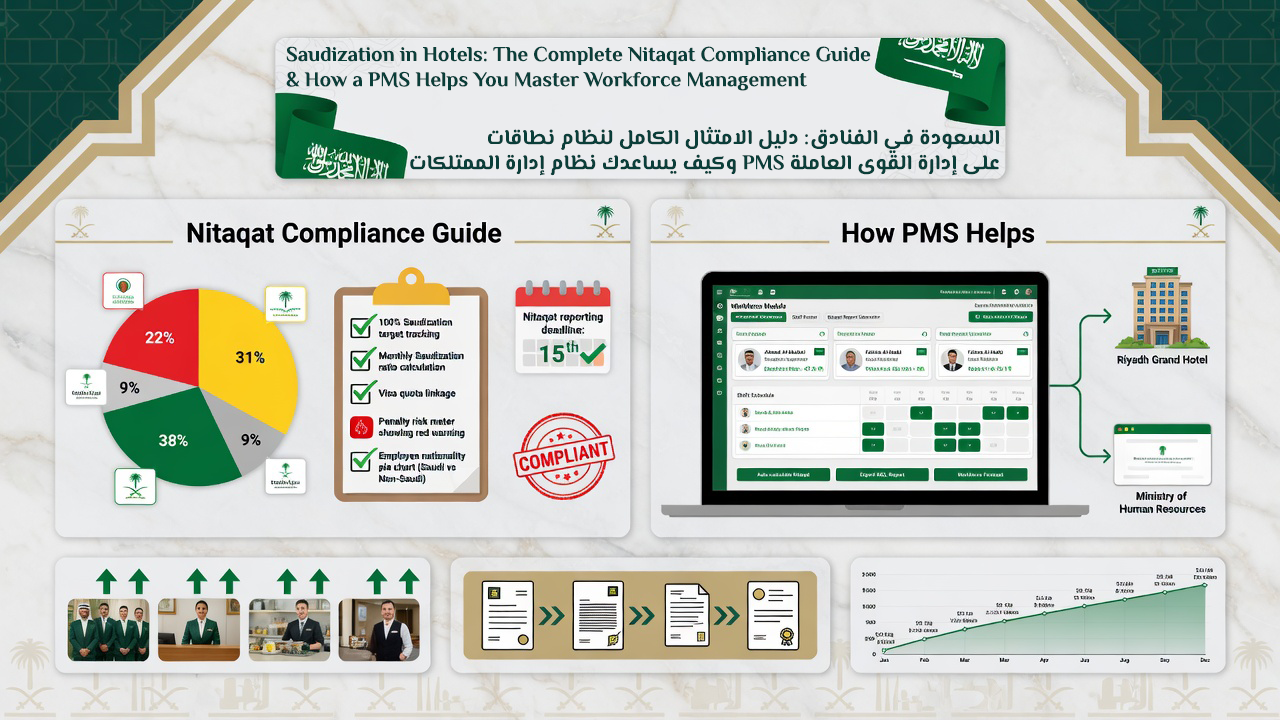
The Nitaqat system is an automated evaluation mechanism that classifies private sector establishments into six color-coded bands based on their job localization percentages. A hotel that invests in accurately understanding these classifications holds a strategic key to managing labor costs and stabilizing operational continuity.
| Classification |
Approximate Localization % |
Impact on the Hotel |
Recruitment Validity |
| Platinum |
Far exceeds the required threshold |
Exceptional privileges & preferential treatment in government projects |
Full + Priority |
| High Green |
Exceeds the required threshold |
All services available + flexible sponsorship transfers |
Fully Available |
| Medium Green |
Meets the minimum required threshold |
Basic services available with minor restrictions |
Available |
| Low Green |
Slightly below the required threshold |
Restrictions on residency renewals & possible extra fees |
Restricted |
| Yellow |
Significantly below the required threshold |
Partial service freeze + limited corrective grace period |
Frozen |
| Red |
Very low or zero |
Complete transaction freeze + financial fines + risk of closure |
Strictly Prohibited |
The table above is indicative. Exact percentages vary based on establishment size and sub-activity. We strongly recommend reviewing the official "Nitaqat" portal monthly.
3. Daily Challenges Hotel Managers Face with Saudization
Managing Saudization in hotels is not merely about inflating numbers in an HR report—it is a complex operational equation where shift schedules, employee turnover rates, peak seasons, and growing guest expectations converge. Here are the most prominent daily challenges hotel operators face:
- Severe Seasonal Fluctuations: A hotel in Makkah may need double the workforce during Ramadan, only to see demand plummet in subsequent months. How do you keep the localization percentage steady amid such swings?
- National Talent Attrition: The turnover rate for Saudi employees in operational roles (front desk, housekeeping) remains high compared to other sectors, making ratio stability difficult.
- Complex Percentage Calculations: The Nitaqat calculation method relies on the 26-week rolling average of Saudi employees, not a single point in time, demanding continuous monitoring.
- Intense Competition for Talent: With new hotels opening almost daily in Riyadh, Jeddah, and the Eastern Province, the race to attract qualified young Saudi nationals is fiercer than ever.
- The Gap Between Training Outputs and Market Demands: New Saudi graduates often require intensive on-the-job training to reach the service standards expected in classified hotels.
Practical Tip:
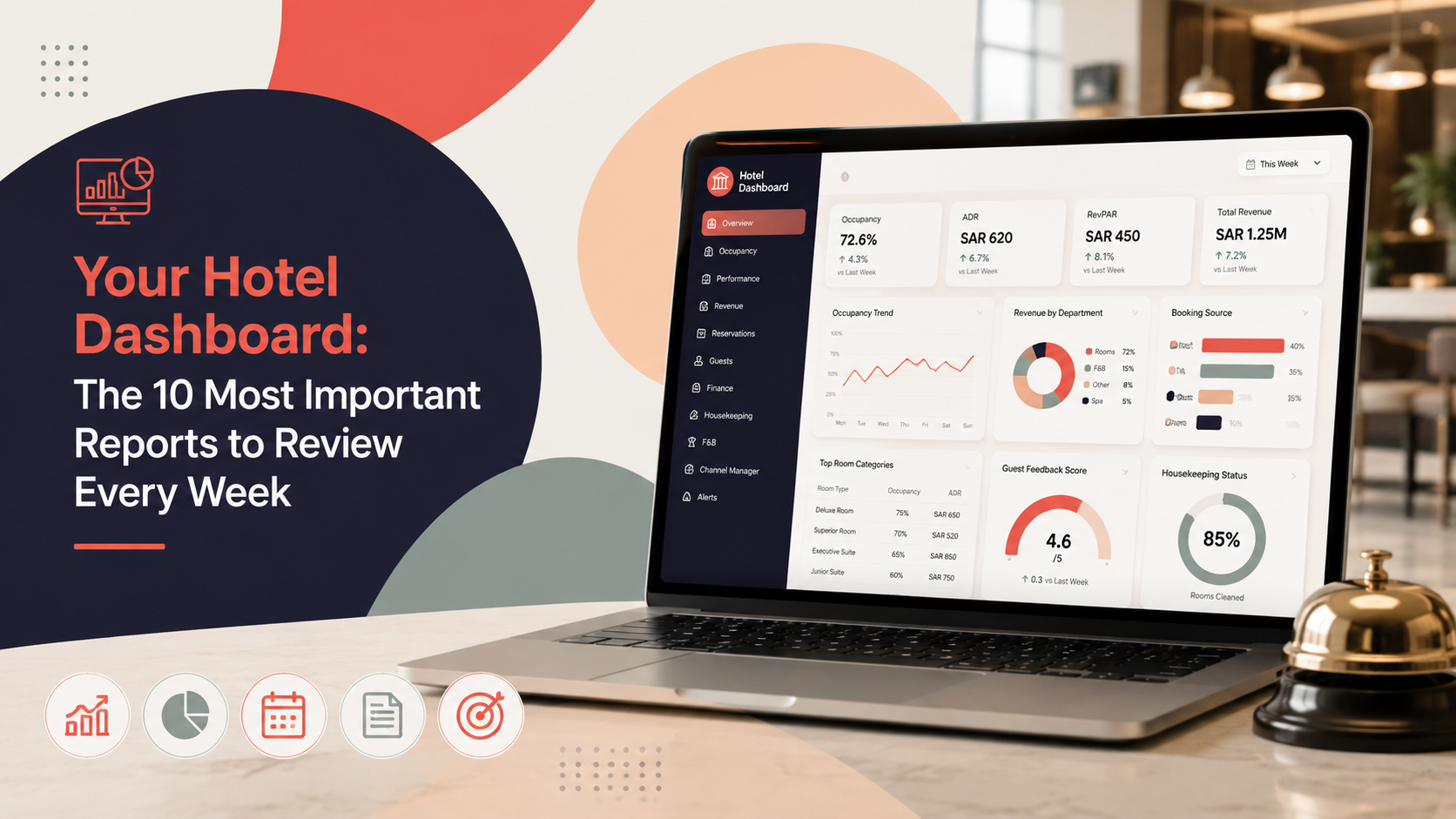
Do not wait until your classification approaches the Yellow Band to take action. Create a monthly dashboard inside your hotel that tracks three numbers every single week: (1) the number of currently active Saudi employees, (2) the localization percentage versus the requirement, and (3) the number of visas available for withdrawal. Make this dashboard visible to senior management.
4. How a Hotel PMS Helps You Manage Saudization Intelligently
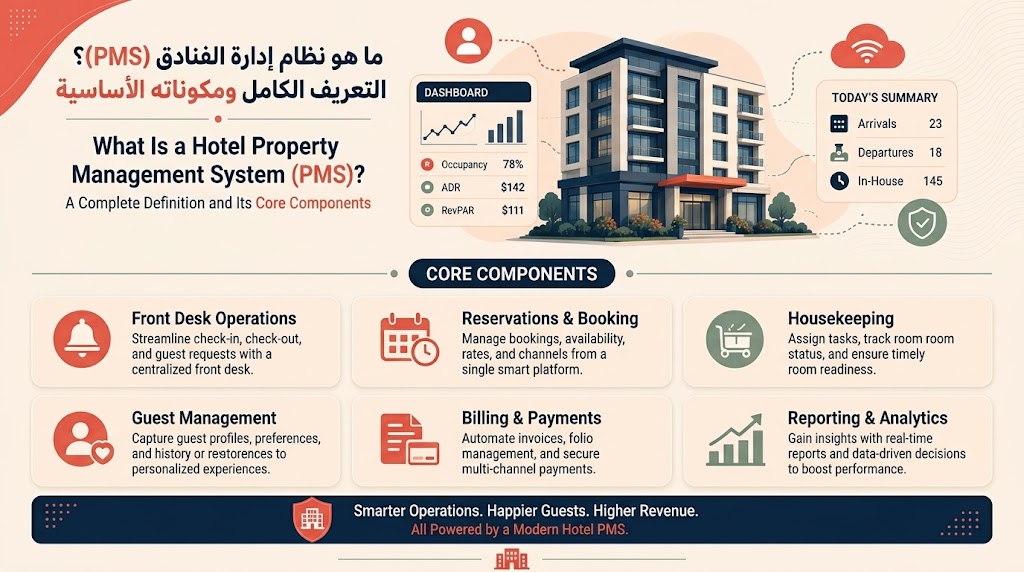
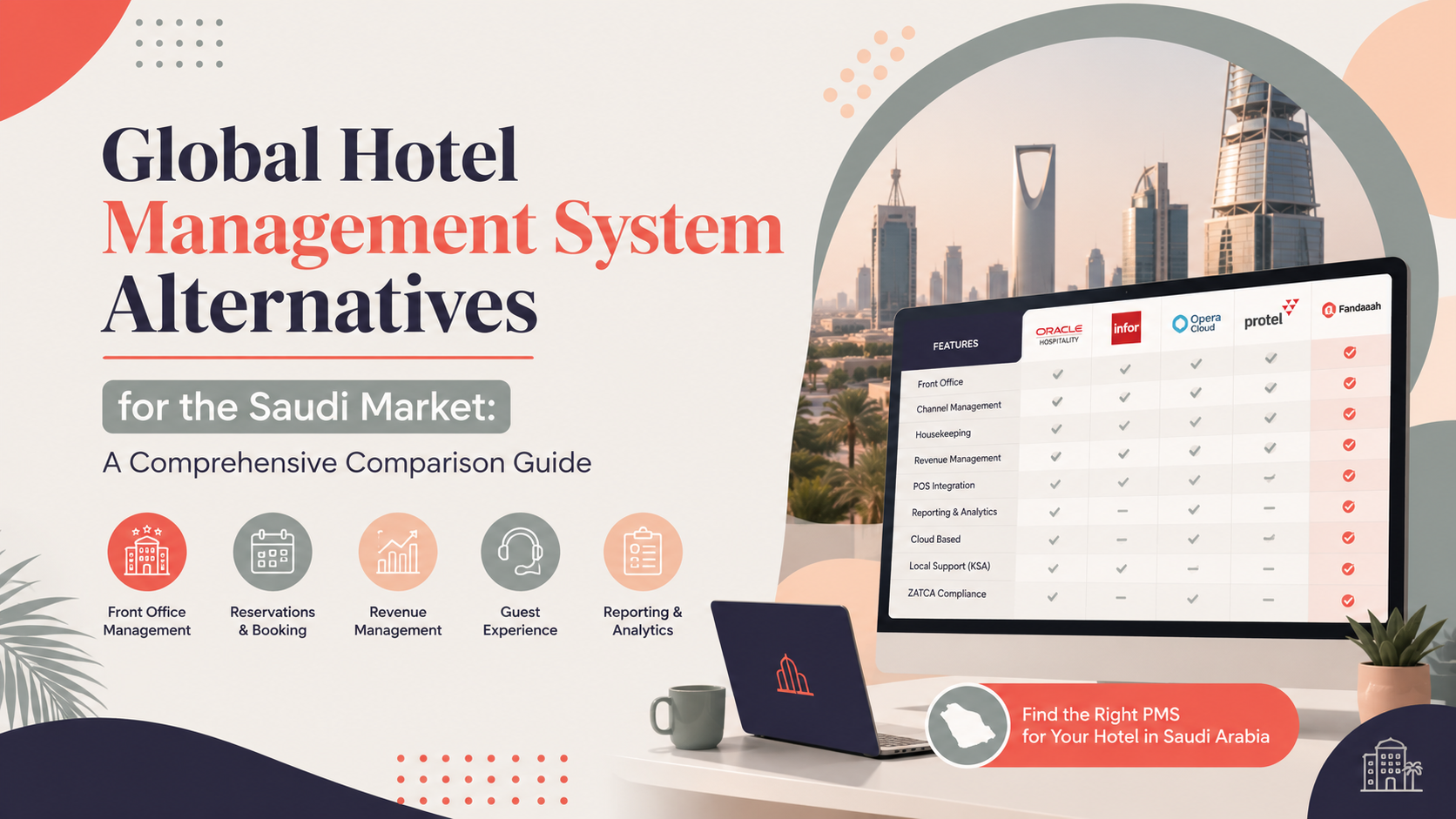
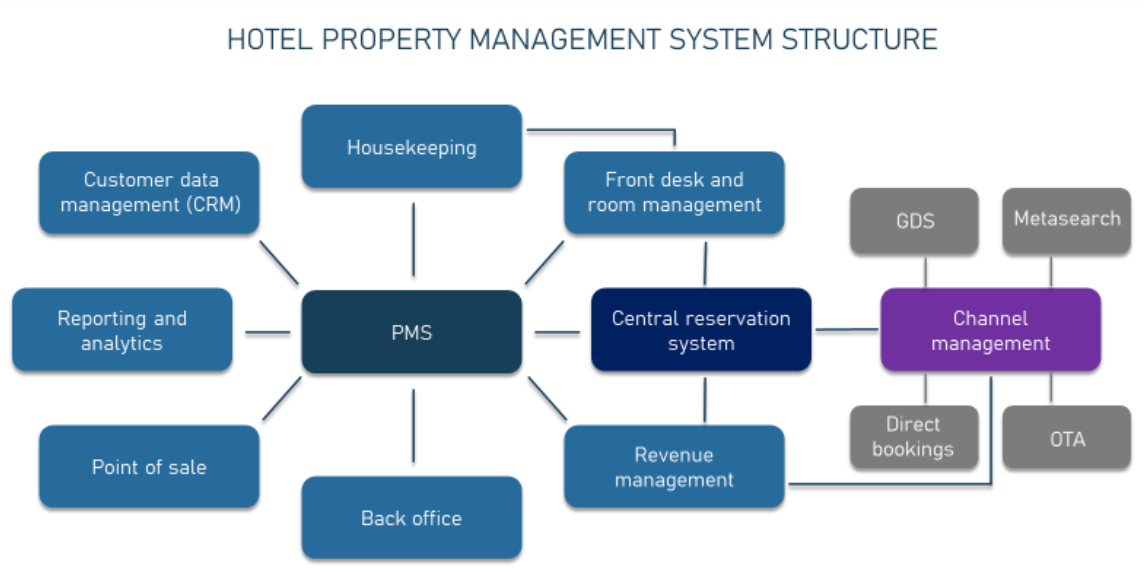
Many hotel operators do not realize that a Property Management System (PMS) can be their strongest ally on the journey to Nitaqat compliance. Beyond its core functions of managing reservations and guests, modern PMS solutions have evolved into integrated platforms for hotel workforce management.
A. Smart Shift Planning Linked to Localization Percentages
Imagine a duty manager trying to build the shift schedule for the upcoming week. An advanced PMS does not merely display available employees—it instantly shows the impact of any adjustment on the hotel's overall localization percentage for the current week and the 26-week moving average. If the manager assigns a shift to an expatriate employee instead of a Saudi on leave, the system alerts them with a warning color: "This adjustment will lower your cumulative classification by 0.4%—do you wish to proceed?"
B. Direct Integration with GOSI and Social Insurance Systems
One of the costliest errors hotels make is discrepancies between internal HR data and GOSI records. A PMS integrated with GOSI interfaces performs automatic periodic synchronization, ensuring every Saudi employee is correctly registered and reported, so no localization points are lost due to a mere administrative oversight.
C. Predictive Compliance Reports
Instead of waiting for the quarterly update from the Nitaqat portal, an advanced PMS provides monthly forecasts of your future classification based on multiple scenarios: What if 3 Saudis resign next month? What if we hire 5 new Saudis? This proactive visibility gives management ample time to make the right hiring decisions.
D. Automated Individual Performance Tracking for Saudi Employees
Localization is not just about hiring—it is about retention and development. Modern PMS solutions include modules for tracking employee performance, engagement, and growth rates, helping hotel management design motivating career pathways for young Saudi nationals, thus reducing attrition and increasing workforce stability.
5. Key Features & Benefits of Using a PMS Specialized in Saudization Management
- Enormous Time Savings: Automation of localization calculations that previously consumed hours of manual work every week.
- Reduction in Human Error: No more forgotten GOSI registrations for Saudi employees or incorrect data entries.
- Proactive Compliance: Early alerts weeks before a potential slide into a lower band.
- Decision-Making Support: Accurate data empowering HR managers to confidently justify hiring requests to senior leadership.
- Comprehensive Integration: Linking workforce data with hotel occupancy data for optimal resource planning.
- Regulatory-Ready Reports: The ability to export compliance reports in approved formats suitable for the Ministry of Tourism and the Ministry of Human Resources requirements.
- Enhanced Employee Experience: Self-service portals for Saudi employees to view schedules, request leave, and track their evaluations.
"The hotel that invests in automating Saudization compliance management today is the hotel that will be free tomorrow to excel in the guest experience—not chase paperwork and reports."
— A Specialist Source in the Saudi Hospitality Sector
6. Real-World Use Cases: Saudi Hotels That Successfully Achieved Compliance
Case Study One: A Luxury Hotel in Riyadh (300+ Rooms)
This hotel was suffering from a classification swinging between Low Green and Yellow for three consecutive quarters. Using an integrated PMS with the Nitaqat-linked shift planning feature, it discovered the problem was not the total number of Saudis but rather their distribution across shifts! Saudi employees were concentrated solely in the morning shift. Through intelligent redistribution backed by system data, the classification jumped to High Green within just 10 weeks—without hiring a single new employee.
Case Study Two: A Mid-Scale Hotel Chain in Jeddah and the Eastern Province
This chain operates 7 hotels, and the centralized HR department was drowning in Excel spreadsheets trying to track localization percentages for each branch. After implementing a unified PMS with a central control panel for workforce management, the regional manager could see the projected Nitaqat classification for each hotel in real time and strategically transfer Saudi talent between branches to optimize the group's overall classification. The result: 3 hotels moved from Yellow to Green, and 2 hotels reached Platinum within 6 months.
Case Study Three: A Boutique Hotel in AlUla (Highly Seasonal)
The biggest challenge here is extreme seasonality—the hotel operates at full capacity only 5 months a year. Using a PMS that supports seasonal contracts recognized by the Nitaqat system, the hotel designed a seasonal employment program for Saudis aligned with localization requirements, where seasonal employees count toward the percentage throughout their contract period, maintaining a stable Medium Green classification even in low-occupancy months.
7. Saudization in Hotels & Vision 2030: Numbers and Aspirations
Saudi Vision 2030 aims to raise the tourism sector's contribution to GDP from 3% to 10% and create one million jobs in the sector. Saudization in hotels is not merely a regulatory requirement—it is the cornerstone for realizing this vision. A hotel managed and operated by qualified young Saudis is a hotel that reflects the Kingdom's identity and culture to visitors from all over the world.
Among the supportive initiatives recently launched:
- The "Ahlan" Training Program: A partnership between the Ministry of Tourism and the Human Resources Development Fund (HRDF), providing intensive training and financial grants to hotels that hire program graduates.
- Saudization Wage Support Initiative: Coverage of up to 50% of the monthly salary for newly appointed Saudi nationals in targeted hotels, for up to 24 months.
- Localization of Tourism and Travel Offices: Localization requirements have extended to include the reservations sector and destination management companies, strengthening the entire tourism value chain.
Future Outlook:
Projections indicate the Ministry of Human Resources will move toward qualitative localization in the hotel sector in the coming years, where the classification will not be based solely on the number of Saudi employees but will also encompass the level of positions they occupy (supervisory, administrative, specialized). Start now building a second line of young Saudi leaders in your hotel.
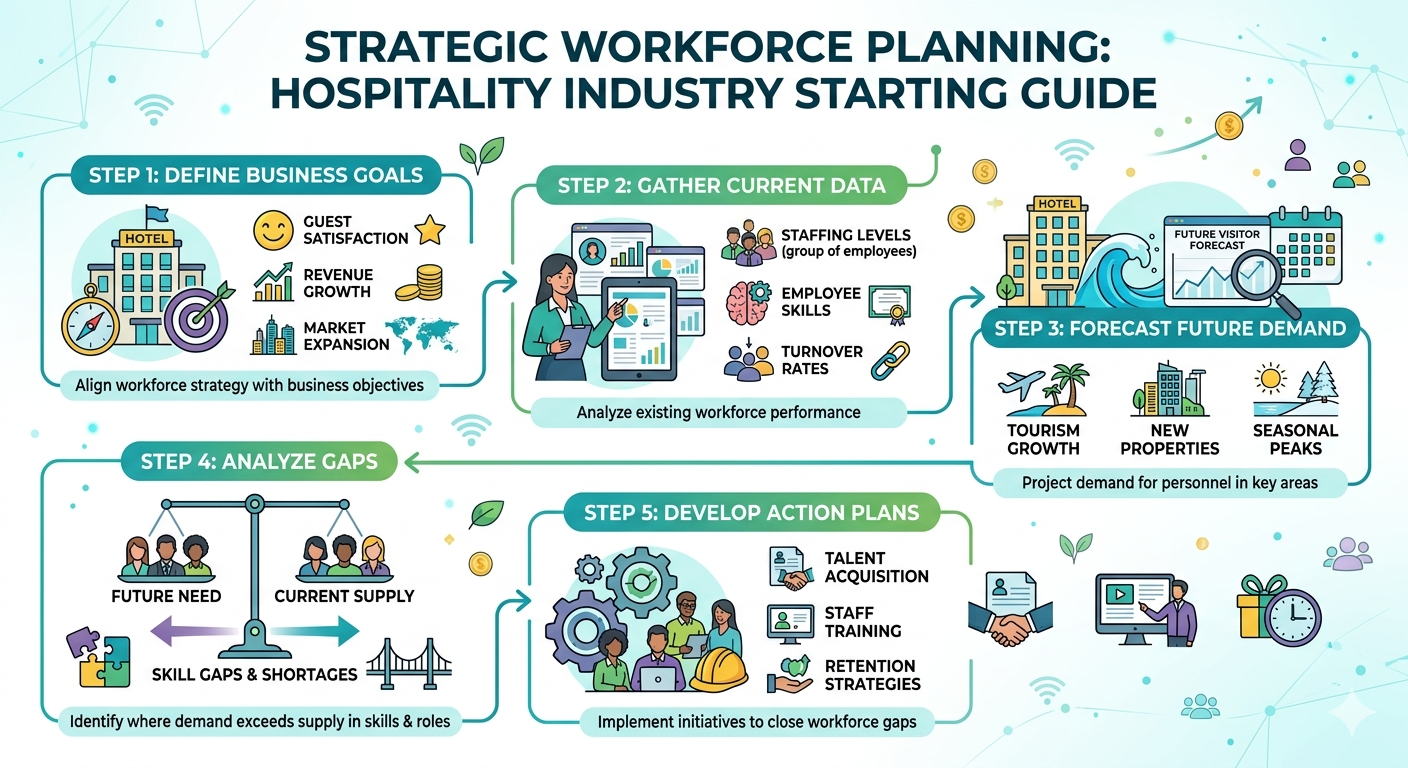
8. A Practical Roadmap to Full Compliance Within 90 Days
Here is a condensed execution plan any hotel in the Kingdom can implement:
| Phase |
Duration |
Key Action |
Output |
| Assessment |
Weeks 1-2 |
Comprehensive audit of GOSI data and cross-checking against hotel records |
Gap Report |
| Planning |
Weeks 3-4 |
Deploy an integrated PMS or activate workforce management modules |
System Ready for Monitoring |
| Execution |
Weeks 5-8 |
Redistribute shifts and intensify corrective hiring |
Tangible Improvement in Ratio |
| Stabilization |
Weeks 9-12 |
Build retention policies and incentive programs for Saudi employees |
Stable Green Classification |
9. Frequently Asked Questions About Saudization in Hotels & the Nitaqat System
Q: What is the exact required Saudization percentage for hotels in Saudi Arabia right now?
The percentage varies depending on the establishment size and activity code in the commercial registration. Generally, major hotels (Category A) are required to achieve percentages starting from 30% up to 49% to reach the High Green band, while smaller hotels may start from around 22%. We strongly recommend visiting the Nitaqat Calculator on the Ministry of Human Resources portal and entering your establishment ID to obtain the exact percentage for your hotel.
Q: Does a part-time Saudi employee count toward the Saudization percentage in hotels?
Yes, a part-time Saudi worker is counted within the percentage but with a lower weight than a full-time worker. The updated Nitaqat system calculates part-time workers based on the number of hours registered with GOSI. A worker registering 80 hours or more per month is counted as nearly one full unit, while those below this threshold are calculated proportionally. This is why an accurate PMS is essential for tracking these details.
Q: How do I handle a Saudi employee who suddenly resigns and affects my classification?
The Nitaqat system grants a grace period of no less than 9 weeks after a Saudi employee departs before the negative impact begins to affect the average percentage. Use this period immediately to search for a Saudi replacement. The system also provides the ability to file an electronic objection if the employee's departure was due to circumstances beyond the hotel's control. A good PMS sends an immediate alert the moment a Saudi employee submits their resignation, starting the grace period countdown.
Q: Can a Saudi employee be transferred between branches of a hotel chain to improve the Nitaqat classification of a specific branch?
Yes, transferring Saudi talent between group branches is a smart and fully legitimate strategy, provided each branch has an independent commercial registration and the employee is formally transferred via GOSI and the Ministry of Human Resources. However, note that the transfer process takes 2 to 4 weeks to reflect in the Nitaqat system, so plan ahead and do not wait until the last moment.
Q: What are the key advantages of the Platinum Nitaqat classification for hotels?
The Platinum classification grants the hotel a package of powerful competitive advantages, including: absolute priority in visa issuance and residency renewals, the ability to transfer sponsorships without the current sponsor's consent, fee reductions on certain government services, and preferential status in nominations for government projects and major tourism contracts. Platinum hotels also enjoy a positive reputation among investors and banks.
Q: Does localization cover all hotel departments or only specific ones?
Currently, the Nitaqat system looks at the overall percentage of the hotel as a whole, but the legislative trend is moving toward department-specific qualitative localization. Directives have already been issued to localize tourism and travel offices attached to hotels, and upcoming waves are expected to specifically target front desk and reservations departments. Modern PMS systems allow filtering reports by department, making it easier to prepare for this trend.
Q: How much does a suitable PMS for Saudization management cost, and is the investment worth it?
PMS costs vary between approximately SAR 1,500 per month for small hotels up to SAR 15,000 or more for major hotels, depending on the number of rooms and activated modules. However, when comparing this cost to a single Nitaqat financial fine or the cost of a one-month recruitment freeze, the return on investment becomes clear. Hotels that adopt an integrated PMS achieve up to 18% annual savings in labor costs due to optimal shift planning and reduced reliance on overtime.
10. Conclusion: Saudization Is an Investment, Not a Cost
At the end of this comprehensive guide, we hope the picture has become clear: Saudization in hotels is not a regulatory burden to circumvent—it is a strategic opportunity to build an authentic and sustainable Saudi hospitality sector. The hotel that invests today in national talent and smart PMS systems for workforce management is the hotel that will reap the fruits of Vision 2030 tomorrow: guests from around the world enjoying genuine Saudi hospitality, a proud national workforce, and a stable Platinum classification that opens the doors to growth and expansion.
Start today with a single step: audit your GOSI data, compare it with your current Nitaqat classification, and consult PMS providers about the solutions available for your hotel category. Compliance is a continuous journey, but with the right tools, the journey becomes smoother and clearer.
Ready to Move Your Hotel to the Green Band and Beyond?
Don't let the Nitaqat classification remain a constant source of anxiety. Speak with workforce management experts in the hospitality sector today and discover how an integrated PMS can transform Saudization from a daily challenge into a sustainable competitive advantage.
Book Your Free Consultation Now →
Or email us directly at info@fandaqah.com | Kingdom of Saudi Arabia
Article Tags:
Saudization in hotels
Nitaqat system
hotel workforce management
PMS for hotels
Saudization compliance
hospitality sector localization
Vision 2030
Nitaqat calculator
GOSI hotels
Saudi hotel management
tourism localization program
property management system